Too many handoffs. The pilot never goes live.
- The rules live with the process owner. Everything else lives with someone else.
- Integration, testing and fixes each sit in a different backlog.
- Industry benchmark: 9 to 14 months from demo to production.

 Leena AI Forge · For process owners
The platform where AI Colleagues are built, shipped, and maintained - by describing what you need in plain English (or German!).
Trusted by the industry leading brands





Describe the automation once. Forge carries it from pilot to go-live to scale, and nothing ships without your approval.
Six steps, one conversation. Nothing live without your approval.
Describe it in plain English or whichever language your team works in, or upload requirements you’ve already written.

Permissions, approvals, and audit trails are built into Forge, not bolted on.
Real AI Colleagues, deployed at real enterprises. Start from one and tell Forge how yours differs.
One platform to build, test, run, and fix AI Colleagues, all through the same conversation. Everything in it is a normal object your team can open and edit by hand.
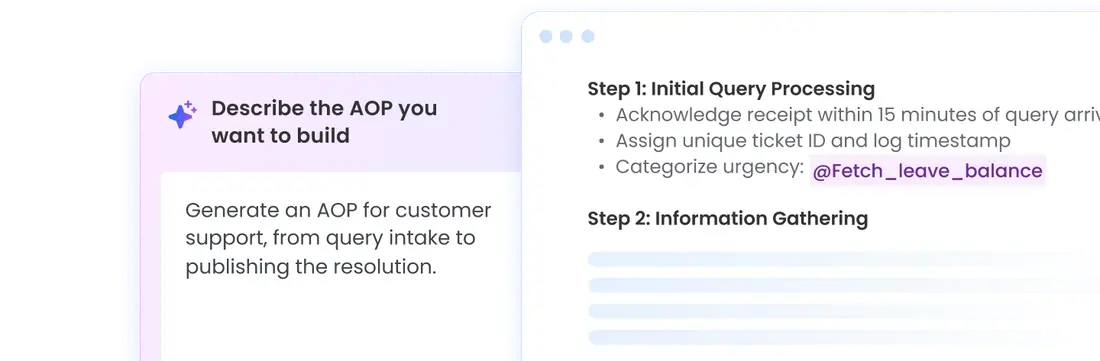
AOPs read like team SOPs. Forge turns your plain-English description into a step-by-step process, and the process owner ships it without an engineer in the room.
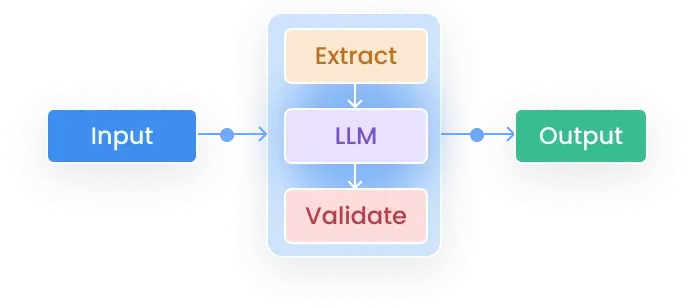
Or start from the marketplace of pre-built AI ColleaguesEach tool is a single action inside an enterprise system. The graph defines the path; the LLM stays in its lane. Forge wires the right tools in and tests them against your cases.
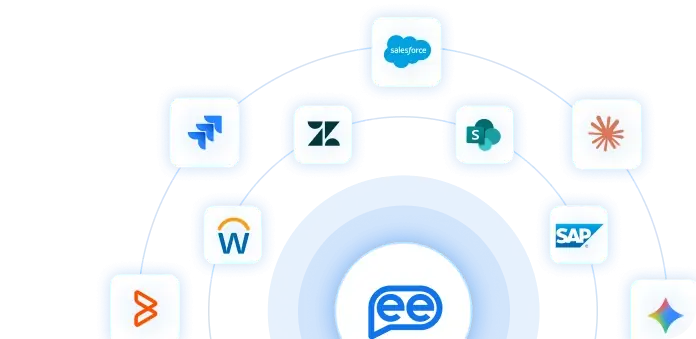
HRIS, ITSM, ERP, identity - one integration layer for the systems that run your enterprise. Forge wires every build into them, and tells you if a connection is missing.
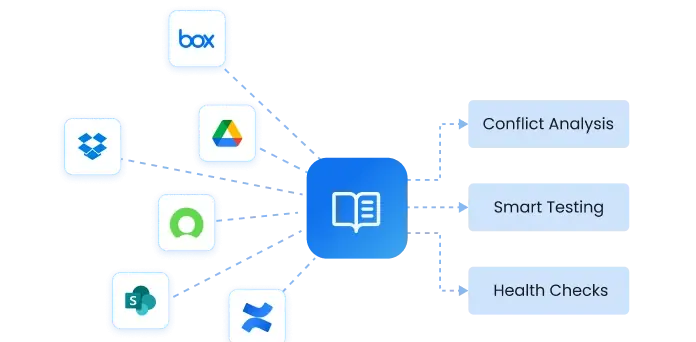
SharePoint, Confluence, Drive, Box, websites. It connects, doesn't copy, and source permissions are inherited. Forge hooks up the sources a process needs – you skip the month-long content project.
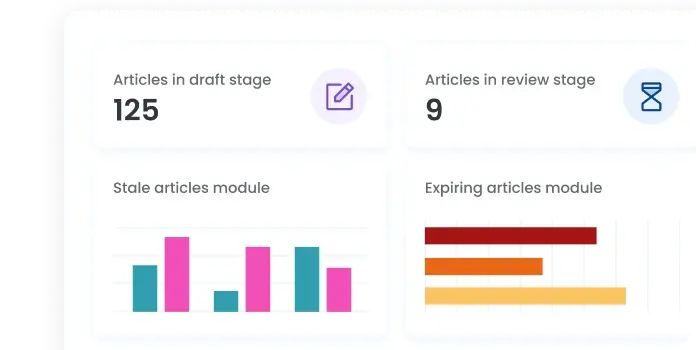
Observability shows what your AI did. Governance decides what it's allowed to do: role-based access, policy guardrails. When a run fails, Forge reads the trace and proposes the fix.
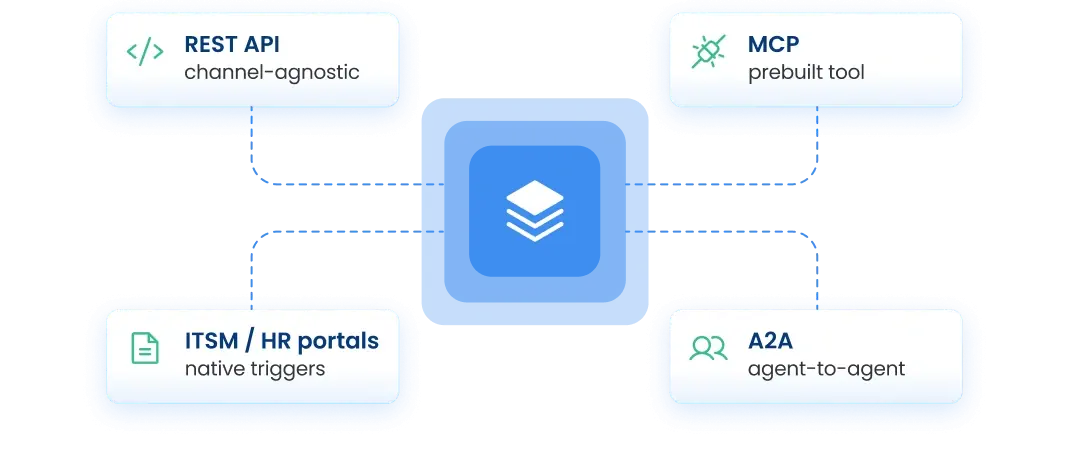
Trigger from anywhere: MCP, A2A, REST API. Point Forge at an MCP server and it drops into any AOP like a normal step.
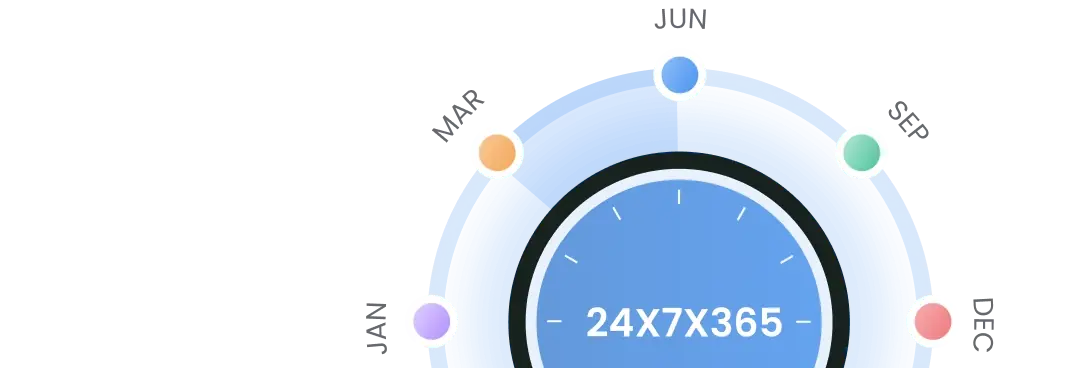
Colleagues don't just wait in a chat window. They run on schedules and system triggers, pause for approvals, and resume with context – 24×7×365. Tell Forge when the work should run; it sets all of it.
Leena AI Forge is Leena AI's platform for building, testing, running, and fixing AI Colleagues, made for process owners in HR, IT, and Finance – no engineering backlog required. Describe the outcome you want, or hand over a requirements document. Forge plans the work, builds the AI Colleague, the AOPs, the tools and the connections into your systems, tests it, and fixes it when it breaks. One conversation, your approval at each step.
Yes. Forge is the new name of the AI Colleagues Platform, and the platform is now agentic. The processes, tools, integrations, knowledge, governance and scheduling that run your AI Colleagues are all still there. What's changed is how you work with them: describe what you want and Forge builds and operates across all of it for you. Everything it makes is a normal object you can open and edit.
No. Forge is the AI Colleagues Platform – one product, one license. It also comes included with the Universal Assistant. No separate SKU or add-on price.
Describing the agent is the easy part, and a workflow builder with an LLM bolted on stops there. The real work is in the tools, the connections into your systems, the testing, and the fixing when something breaks. Forge does all of those. Nobody has to work out the APIs, write test cases, or read logs to find out why a run failed.
No. Forge sees and does only what the person using it can. Every change is proposed first and waits for approval. It reads from live systems during testing but asks before it changes anything. Nothing it does in a test environment can reach your live one.
43 days on average today, inside the 45 we promise. Two years ago it was 187. The industry benchmark for comparable systems is 9 to 14 months. Forge is how we take that to hours.
An AOP is a process graph that mirrors how business teams already think: steps, owners, approvals, SLAs. Each step is filled with a deterministic tool from the registry, and the LLM reasons only inside the rails the AOP defines. Forge writes the first draft from your description. Process owners edit it like an SOP.
An AI agent runs a task. An AI Colleague owns a process. Agents drift because they invent the workflow on the fly. Colleagues stay on rails: AOPs define the work, tools execute it, and the LLM reasons inside fixed boundaries. Forge builds Colleagues, so what it ships behaves the same way on run one and run one thousand.
Structured knowledge steps, primary plus evaluator LLMs, positive and negative examples, and a full audit trail. High-risk actions are tool-locked, and each tool knows exactly which fields it can touch. Forge runs test cases from your requirements before anything goes live, so you see failures before your employees do.
Every Colleague run is fully stateful. If an external system fails, times out or returns invalid data, the Colleague can retry, roll back or escalate with prior context intact. Ask Forge why the run failed and it explains the cause in plain language and proposes the fix for your approval.
Four layers end to end: LLM fine-tuning, AI Colleague configuration, AOP and execution, and the system prompt. RBAC across Colleagues, AOPs and tools. Source permissions inherited, never re-implemented. Every change runs as the person who asked for it, with a full audit trail.
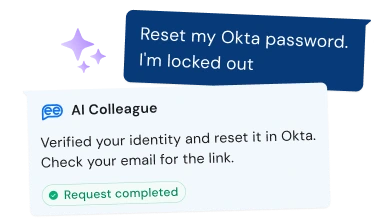
Two ways. Employees and managers can simply ask: Forge builds Employee Self Service (ESS) and Manager Self Service (MSS) use cases too, so a question in the Leena AI universal assistant can start an AI Colleague. Systems can trigger them through REST APIs, MCP and A2A, plus schedules and system events like a new employee landing in the HRMS. Invoke from ITSM tools, HR portals and custom apps – including Workday, ServiceNow, SAP SuccessFactors and Okta – or on a cron. Tell Forge when the work should run and it sets up the triggers.
Yes. Built for restricted data (PII/PHI). HIPAA, SOC 2 Type II, ISO/IEC 27001, 27701, 27017, 27018. AES-256-GCM at rest, TLS 1.2+ in transit, AWS KMS-managed keys. Shared public cloud, isolated single-tenant cloud or private VPC across 14+ regions, with tamper-evident audit trails.
 Workday · IT · Calendar