Most enterprise AI sounds
smart and acts dumb.
Memory and Context Graph are how Leena AI Colleagues operate with real judgment.
Five layers of grounded knowledge underneath every decision, and a structured graph of
every exception — so the same problem doesn't get solved twice.
Two systems underneath
every Colleague.
Most "AI memory" is chat history. That's fine for a chatbot — useless for an agent making decisions
in your stack. Leena AI Colleagues run on two distinct systems, and both are required.
What a Colleague knows.
Your industry, your policies, your processes, the person it's working with, and the live task at hand. All grounded, all permission-aware, all loaded before the Colleague picks up the work.
It doesn’t show up to work clueless.
What it learns from doing the work.
Every exception, every judgment call, every "what's the right move here" gets written down as a structured precedent — nodes, edges, conditions, rationale. Next time the same pattern shows up, the Colleague resolves it in seconds.
It gets sharper every week.
Five layers, working together.
Each one decides what a Colleague pulls, considers, and acts on.

Domain knowledge
How HR, IT, finance, and procurement actually work — pre-trained into the orchestrator. The Colleague knows what a purchase order is before it sees yours.

Company knowledge
Your policies, SOPs, and approval matrices — pre-indexed with permissions ported in. Searched against, not searched at runtime.

User
memory
Role, authority, reporting line, history — pulled live from Workday, AD, or whichever system holds the truth.

Session context
The live task at hand. Holds intent across multi-step workflows so the Colleague doesn't lose the thread.

Decision trace
Exceptions become structured precedent. The same edge case resolves in seconds the next time it shows up.
What “enterprise-grade”
actually means.
Four properties that separate a Colleague from a wrapped LLM.
Consistency at scale
Same input, same call — whether it's Tuesday at 10 a.m. or Sunday at 2 a.m. No drift from one run to the next.
Less escalation
Every resolved exception becomes a reusable precedent. The volume of work that needs a human shrinks every quarter.
Sub-second by design
Knowledge is pre-indexed, not searched at runtime. Latency users actually feel.
Audit-ready
Every decision carries who, why, when, and on what conditions. Inspectable end to end.
Most enterprise AI is a chat layer over a search index. This isn't.
The shortcut most vendors take: index your documents, retrieve relevant chunks, generate an
answer. That works for Q&A. It doesn't work for an agent making real decisions in your stack.
Here's what Leena AI does instead.

Static SOPs that break on edge cases

Living precedents that sharpen every week
Silent learning buried in model weights
Explicit learning - the Colleague asks: what's the call?
Chat history treated as memory
A structured graph: nodes, edges, conditions, rationale
Generic LLMs guessing at enterprise context
Five-layer memory grounded in your studio
Latency users feel at runtime.
Pre-indexed, permission-aware retrieval
Static SOPs that break on edge cases
Silent learning buried in model weights
Chat history treated as memory
Generic LLMs guessing at enterprise context
Latency users feel at runtime.
Living precedents that sharpen every week
Explicit learning - the Colleague asks: what's the call?
A structured graph: nodes, edges, conditions, rationale
Five-layer memory grounded in your studio
Pre-indexed, permission-aware retrieval
Inside the Agentic AI architecture
Touchpoints
Your people work in Teams, Slack, email, voice, browsers, portals. AI Colleagues show up there. Not somewhere else.
 8+ channels. Zero context switching.Same agent, same memory, every surfaceTalks back. Reaches out. Doesn't wait to be asked.
Orchestrator
The brain. Reads the request, builds the plan, calls the right AI Colleague, routes between models on the fly. Model-agnostic by design - runs on Claude Opus 4.8, WorkLM™️, GPT 5.5, Llama 4, or Gemini 3.5.
Plans are built, not pre-codedBreaks complex asks into doable subtasksHands off cleanly between agents over A2AAI Colleagues
Level 3 digital workers, each grounded by Agent Operating Protocols (AOPs), equipped with Tools to act in enterprise apps, powered by Context Graph and Memory, and managed via a Workbench.
Always on. 24/7. No human trigger.Gets smarter with every interaction via the Context GraphHandle exceptions like a person would. No "I didn't understand."Studios
Three no-code studios that let business users design, assemble, and ground AI Colleagues in plain English. AOP Studio writes the process. Workflow Studio wires in the tools. Knowledge Studio connects the truth.
Kickoff to live in days, not monthsBusiness users own and iterate without engineering1000+ pre-built tools across 200+ enterprise systemsPermissions and Access Controls
AI Colleagues only see and do what their role allows - across every system you connect. Permissions stay tied to your existing tools.
Inherits from your IdP. No re-mapping.Every action audit-logged and identity-boundSafe for multi-team, multi-tenant deploymentsIntegrations
200+ pre-built enterprise connectors across ServiceNow, Workday, SAP, Oracle, Salesforce, UKG, SharePoint, Snowflake, and more — via APIs, MCP, A2A, and browser/RPA.
200+ live on day oneConnect in minutes, no custom codeAPI + RPA + browser fallback. Nothing's "we can't integrate."Observability and Governance
Responsible AI layer, built into every AI Colleague. See every step, govern every action. Dashboards for execs, ops, and risk.
Full trace: what the agent did, why, what it readGuardrails at every layer - enforced before executionEval Suite catches regressions. Quality trends up, not sidewaysTrust and Security
Agentic AI security built into the architecture, not bolted on. SOC 2, ISO 27001, HIPAA, AES-256-GCM.
AES-256 at rest, TLS 1.2+ in transit, AWS KMS-managed keysShared, single-tenant, or private VPC across 14+ regionsSSO, MFA, and RBAC for staff and customer adminsPick your next stop
Hand-picked next reads — short on filler, long on what matters.
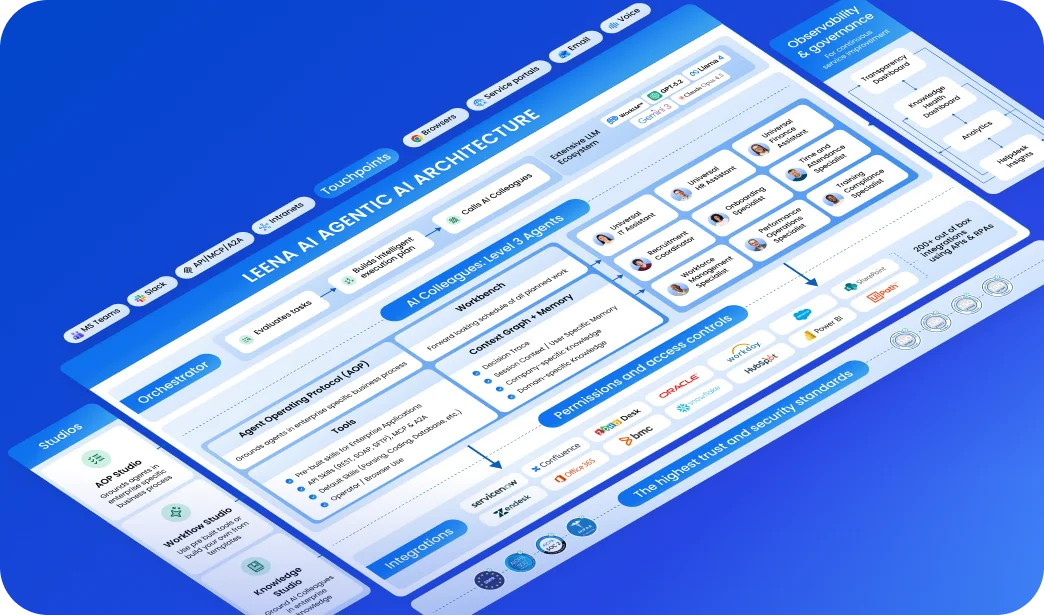
Agentic AI Architecture
The platform Fortune 500s use to build, govern, and run enterprise AI Colleagues.
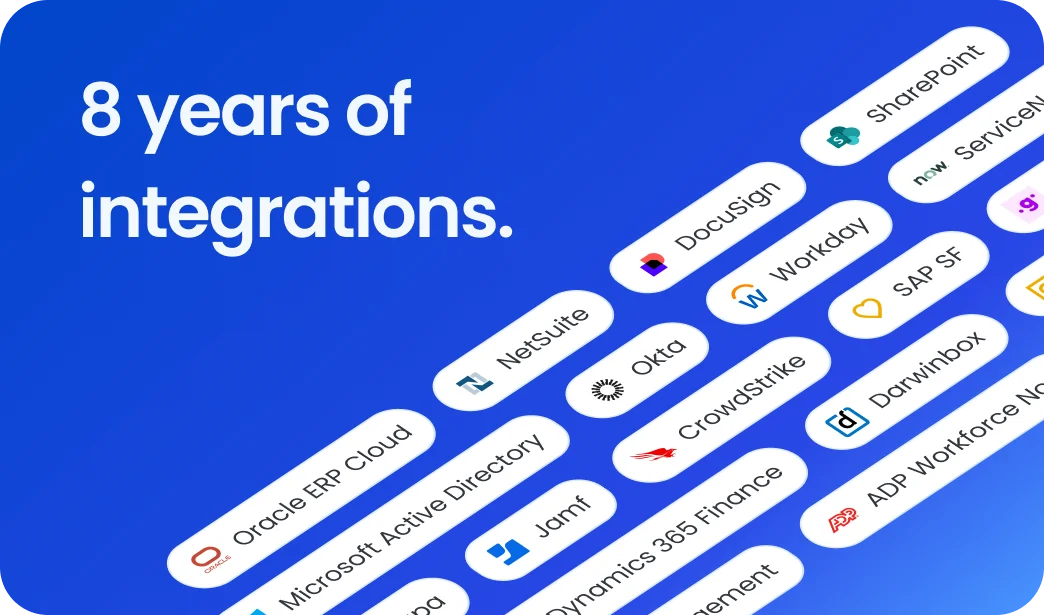
8 Years of Integrations
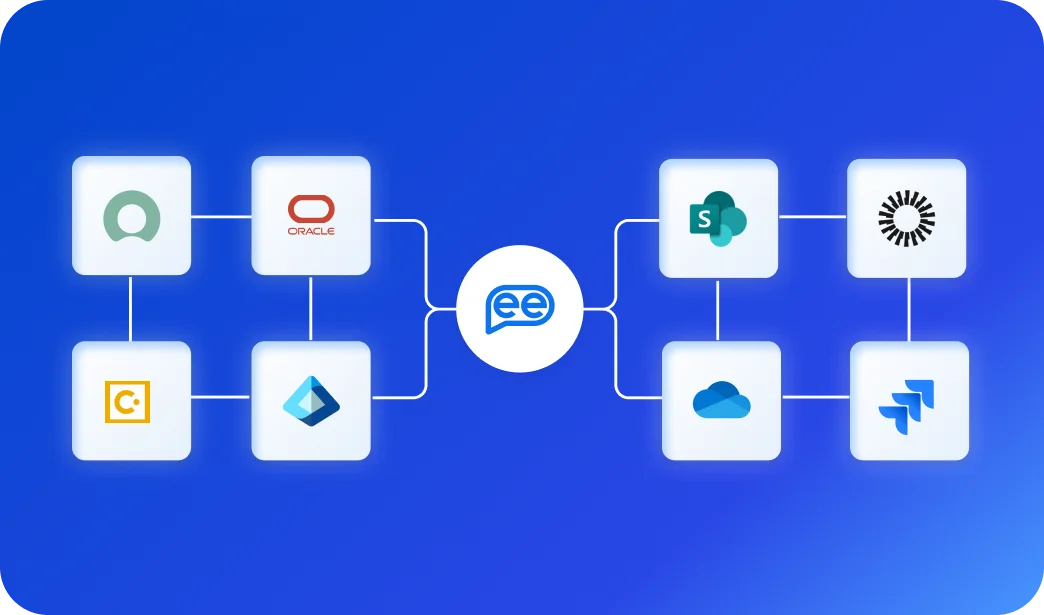
One integration layer, 200+ systems of record, battle-tested in 500+ enterprises over 8 years.
Avoid Vendor Lock-In
No OEM money. No vested interest. No vendor lock-in. We connect to all of them.
Leena AI Documentation
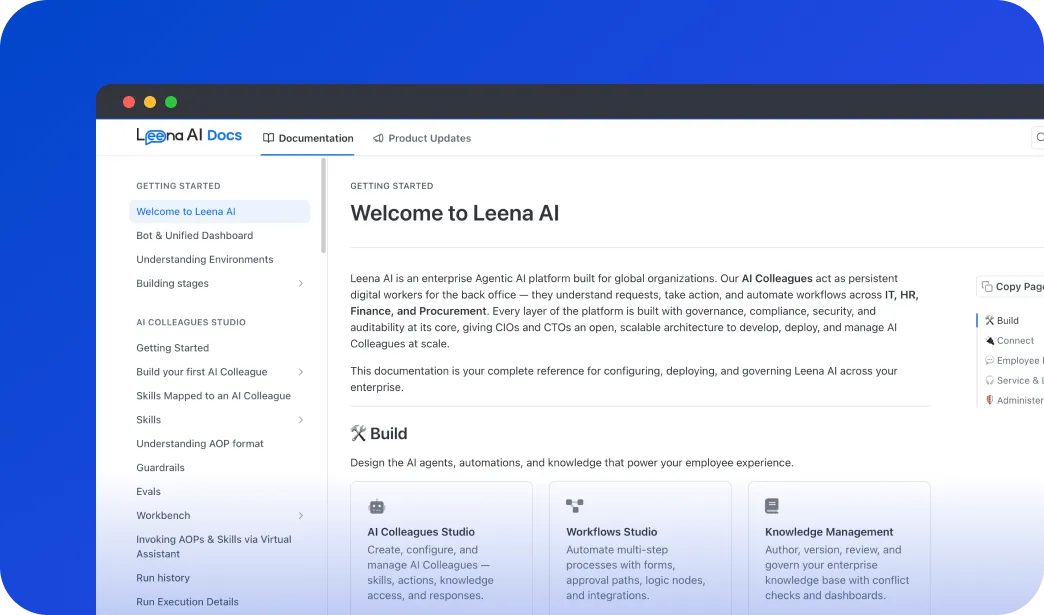
Your reference for configuring, deploying, and managing AI Colleagues at scale.
Frequently asked questions
What is a Context Graph?

How is a Context Graph different from RAG?
Does the Colleague respect user permissions?
What happens when reality doesn't match the playbook?
Is every decision auditable?
How is memory grounded? does the Colleague hallucinate facts?
How does the Context Graph stay current as policies change?
Can the Context Graph be exported or inspected?