Permissions, enforced at
runtime.
Your existing access model - already in Active Directory, Workday, and your source systems.
Leena AI enforces it on every AI Colleague, on every step, before the action lands.
The control layer for what
an AI Colleague can
know and do.
Observability shows what the agent did. This is the layer that kept it inside the lines in the first place.
Six layers. All enforced
before the agent acts.
The surface view. Each layer goes deeper — we'll walk you through it in a demo.

Source permissions, inherited
200+ enterprise integrations carry their access models with them. Permissions stay in the source system - no second table to manage, no second table to drift.

RBAC that mirrors your organisation
Directory sync from Active Directory and your HRIS. Role-based controls at the AI Colleague level, the AOP level, and the individual skill level.

Four-layer guardrails at runtime
Enforced at the model, the AI Colleague, the execution path, and the prompt. Out-of-policy actions are blocked — not flagged after the fact.

Deterministic tools, not improv
Every tool knows its target system and validated fields. High-risk actions sit behind explicit approvals — record updates, provisioning, money movement.

Tenant isolation by design
Public cloud, single-tenant, or private VPC. 14+ deployment regions. Pick the model that fits your risk profile and data residency requirements.

Encrypted, certified, evidenced
AES-256-GCM at rest. TLS 1.2+ in transit. SOC 2 Type II, ISO 27001, ISO 27017, ISO 27018, ISO 27701, HIPAA, GDPR. Pentest reports and compliance artifacts in the Trust Center.
Read-only chat leaks an answer. An autonomous worker moves money.
AI Colleagues act. That changes the math.
Records get updated. Access gets granted. Money moves — at machine speed, across systems, without a human in the loop on every step. This is the layer that lets a CISO say yes to scaling AI Colleagues across HR, IT, Finance, and Procurement without multiplying the attack surface. Every action is attributable to the user it was taken for. Every guardrail fires before the call lands, not after.
When AI takes action, bad permissioning isn't a UX problem. It's an audit finding.
Permissions in the architecture,
not in the SKU.

Inherited, not duplicated
200+ enterprise integrations carry their access models with them. There's no second permissions table to maintain — and no second table to fall out of sync with the source.
Built for restricted data from day one
The platform was designed for PII and PHI workloads, not retrofitted. Healthcare and financial services customers run on the same architecture you'll deploy.
Enforced at runtime, not reviewed retroactively
Guardrails fire before the AI Colleague acts. Continuous enforcement, not a quarterly access review that finds the problem three months late.
Defense in depth, not a single checkpoint
Five enforcement surfaces stacked: RBAC, tenant isolation, source-system inheritance, four-layer runtime guardrails, and a full trace log. Failing one doesn't compromise the others.
Fast to deploy, still fully governed
Pre-indexed knowledge, pre-built connectors, security groups intact from the source. Live in days, governed from the first run.
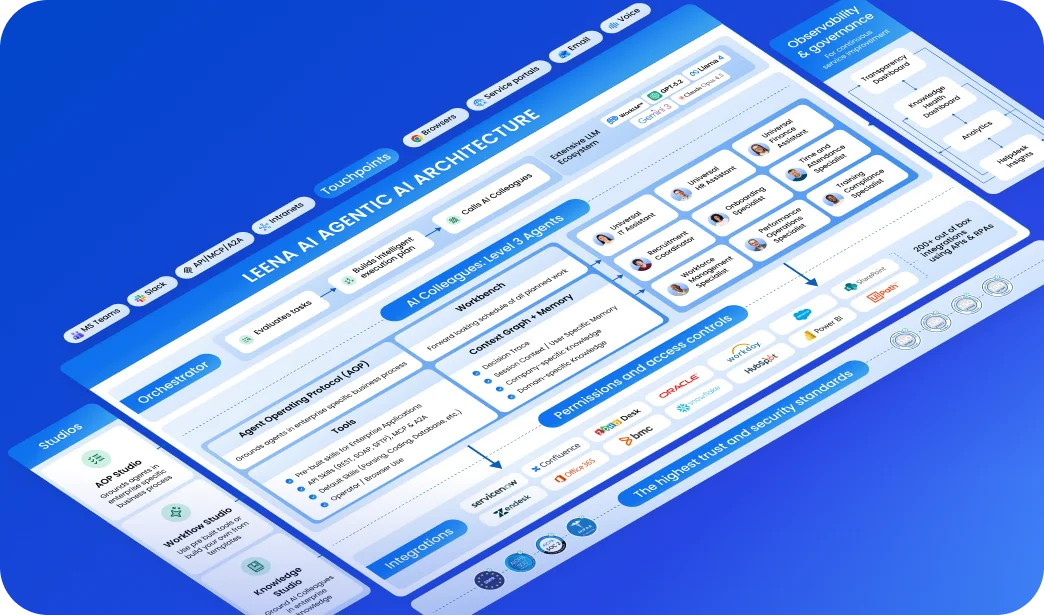
Inside the Agentic AI architecture
Touchpoints
Your people work in Teams, Slack, email, voice, browsers, portals. AI Colleagues show up there. Not somewhere else.
 8+ channels. Zero context switching.Same agent, same memory, every surfaceTalks back. Reaches out. Doesn't wait to be asked.
Orchestrator
The brain. Reads the request, builds the plan, calls the right AI Colleague, routes between models on the fly. Model-agnostic by design - runs on Claude Opus 4.8, WorkLM™️, GPT 5.5, Llama 4, or Gemini 3.5.
Plans are built, not pre-codedBreaks complex asks into doable subtasksHands off cleanly between agents over A2AAI Colleagues
Level 3 digital workers, each grounded by Agent Operating Protocols (AOPs), equipped with Tools to act in enterprise apps, powered by Context Graph and Memory, and managed via a Workbench.
Always on. 24/7. No human trigger.Gets smarter with every interaction via the Context GraphHandle exceptions like a person would. No "I didn't understand."Studios
Three no-code studios that let business users design, assemble, and ground AI Colleagues in plain English. AOP Studio writes the process. Workflow Studio wires in the tools. Knowledge Studio connects the truth.
Kickoff to live in days, not monthsBusiness users own and iterate without engineering1000+ pre-built tools across 200+ enterprise systemsPermissions and Access Controls
AI Colleagues only see and do what their role allows - across every system you connect. Permissions stay tied to your existing tools.
Inherits from your IdP. No re-mapping.Every action audit-logged and identity-boundSafe for multi-team, multi-tenant deploymentsIntegrations
200+ pre-built enterprise connectors across ServiceNow, Workday, SAP, Oracle, Salesforce, UKG, SharePoint, Snowflake, and more — via APIs, MCP, A2A, and browser/RPA.
200+ live on day oneConnect in minutes, no custom codeAPI + RPA + browser fallback. Nothing's "we can't integrate."Observability and Governance
Responsible AI layer, built into every AI Colleague. See every step, govern every action. Dashboards for execs, ops, and risk.
Full trace: what the agent did, why, what it readGuardrails at every layer - enforced before executionEval Suite catches regressions. Quality trends up, not sidewaysTrust and Security
Agentic AI security built into the architecture, not bolted on. SOC 2, ISO 27001, HIPAA, AES-256-GCM.
AES-256 at rest, TLS 1.2+ in transit, AWS KMS-managed keysShared, single-tenant, or private VPC across 14+ regionsSSO, MFA, and RBAC for staff and customer adminsPick your next stop
Hand-picked next reads — short on filler, long on what matters.
Agentic AI Architecture
The platform Fortune 500s use to build, govern, and run enterprise AI Colleagues.
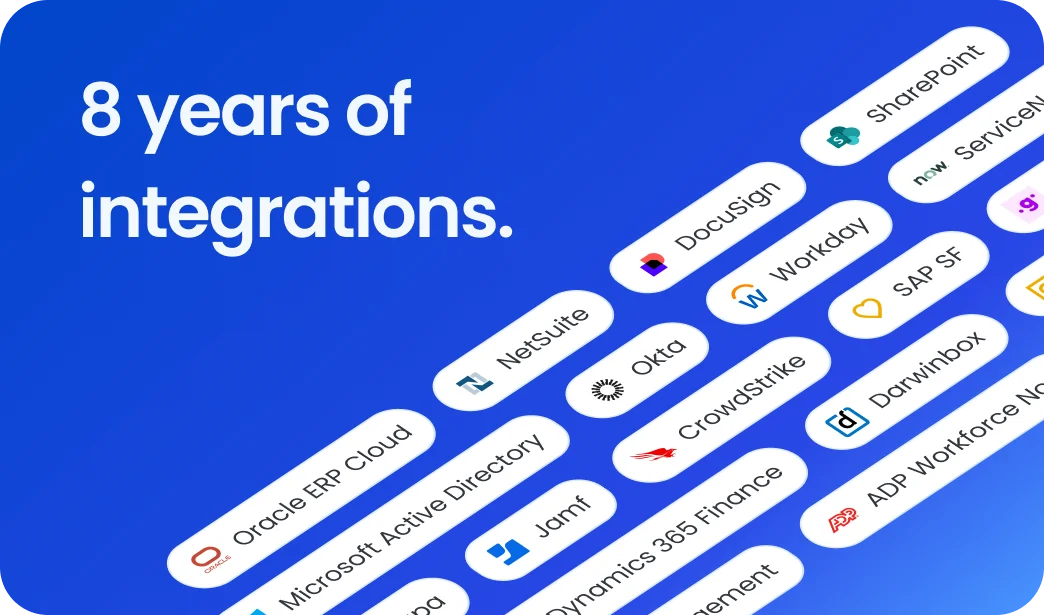
8 Years of Integrations
One integration layer, 200+ systems of record, battle-tested in 500+ enterprises over 8 years.
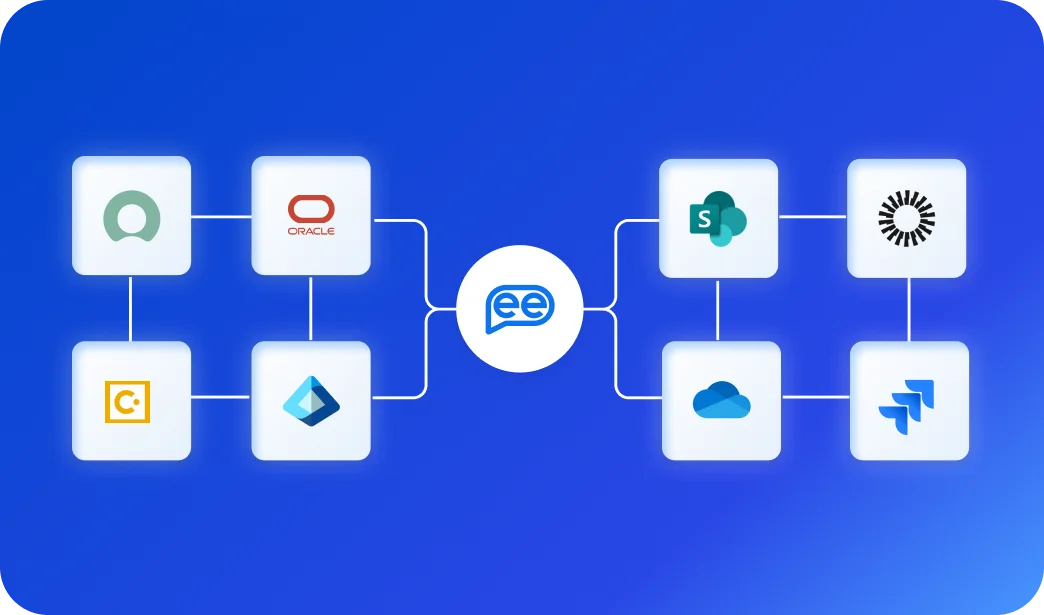
Avoid Vendor Lock-In
No OEM money. No vested interest. No vendor lock-in. We connect to all of them.
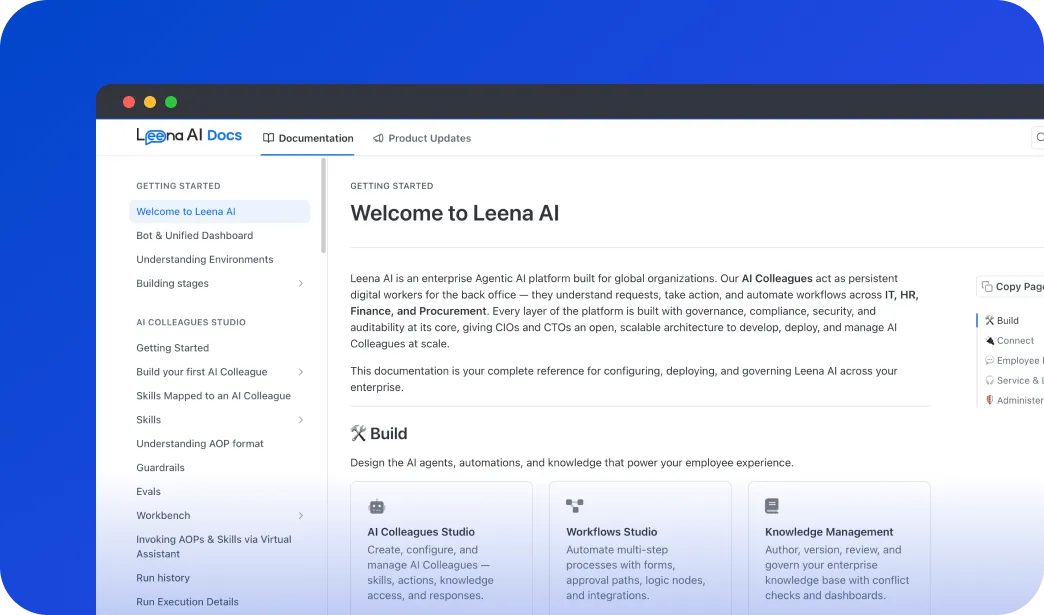
Leena AI Documentation
Your reference for configuring, deploying, and managing AI Colleagues at scale.
Frequently asked questions
How does Leena AI handle permissions for AI Colleagues?

What's the difference between AI observability and AI access controls?
Are Leena AI's AI Colleagues safe for handling PII and PHI?
Are guardrails enforced at runtime, or after the fact?
Can Leena AI be deployed in a private VPC?
Will an AI agent ever take an action my employees can't?
How long does it take to deploy AI Colleagues with proper access controls?
What approvals are required for high-risk AI agent actions?
What happens if a user's permissions change in the source system?
How does Leena AI handle service accounts and non-human triggers?
Is the audit log immutable?