What IBM Ventures’ Investment in Leena AI Really Means
IBM Ventures announced a strategic investment in Leena AI on October 19. The press release says what happened. This post is about why.
IBM Ventures announced a strategic investment in Leena AI on October 19. The press release says what happened. This post is about why.
The promise is real. The compounding return is not.
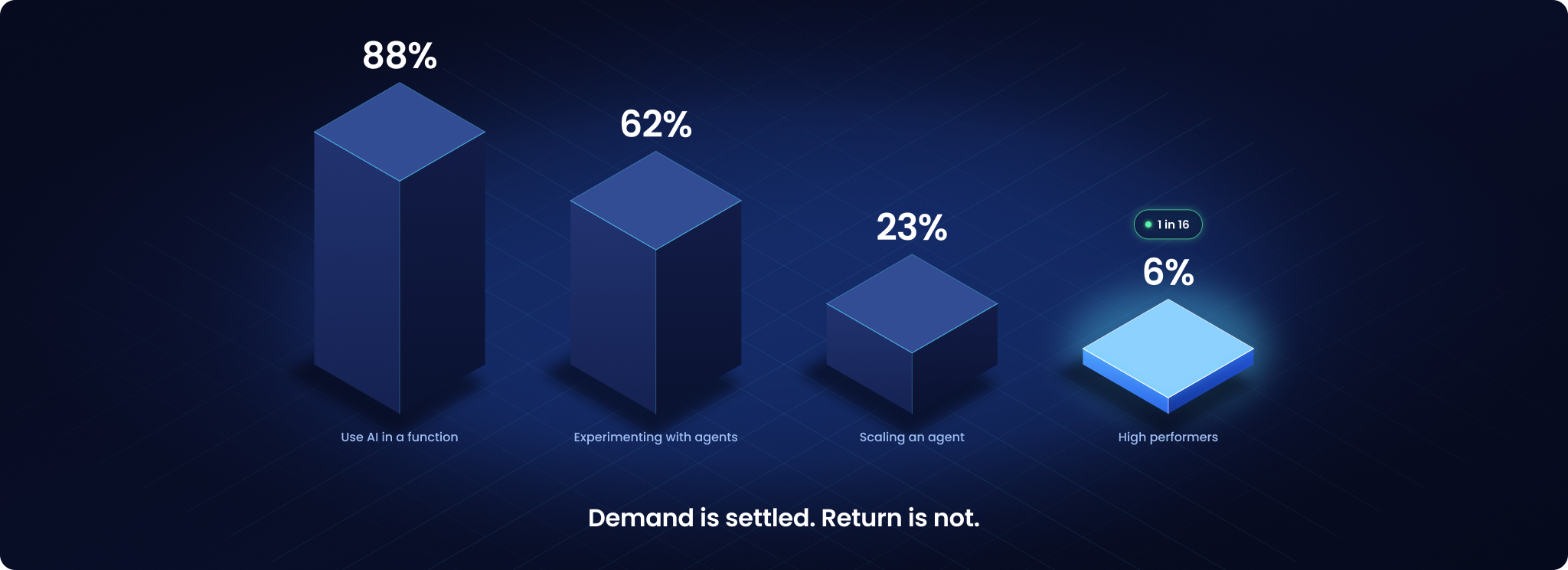
Agentic AI is no longer a thesis. It is a budget line. McKinsey’s State of AI 2025 finds 88% of organizations now use AI in at least one function, and 62% are at least experimenting with agents. The demand is settled.
The return is not. In the same survey, only 23% are scaling an agentic system anywhere, and in no single function does that number cross 10%. Just 39% attribute any EBIT impact to AI, and most of those put it under 5%. Only about 6% of companies qualify as high performers, meaning AI moves at least 5% of EBIT. One in sixteen.
MIT’s GenAI Divide report puts it more bluntly: 95% of enterprise pilots stall before producing meaningful financial return. The lead author calls it a “learning gap” between the tools and the enterprise workflows they are dropped into. Models are not the constraint. Integration is.
Gartner forecasts that more than 40% of agentic AI projects will be cancelled by the end of 2027, citing rising cost, unclear value and inadequate risk controls. Of the thousands of vendors claiming to be agentic, Gartner counts roughly 130 that are. The rest is agent-washing.
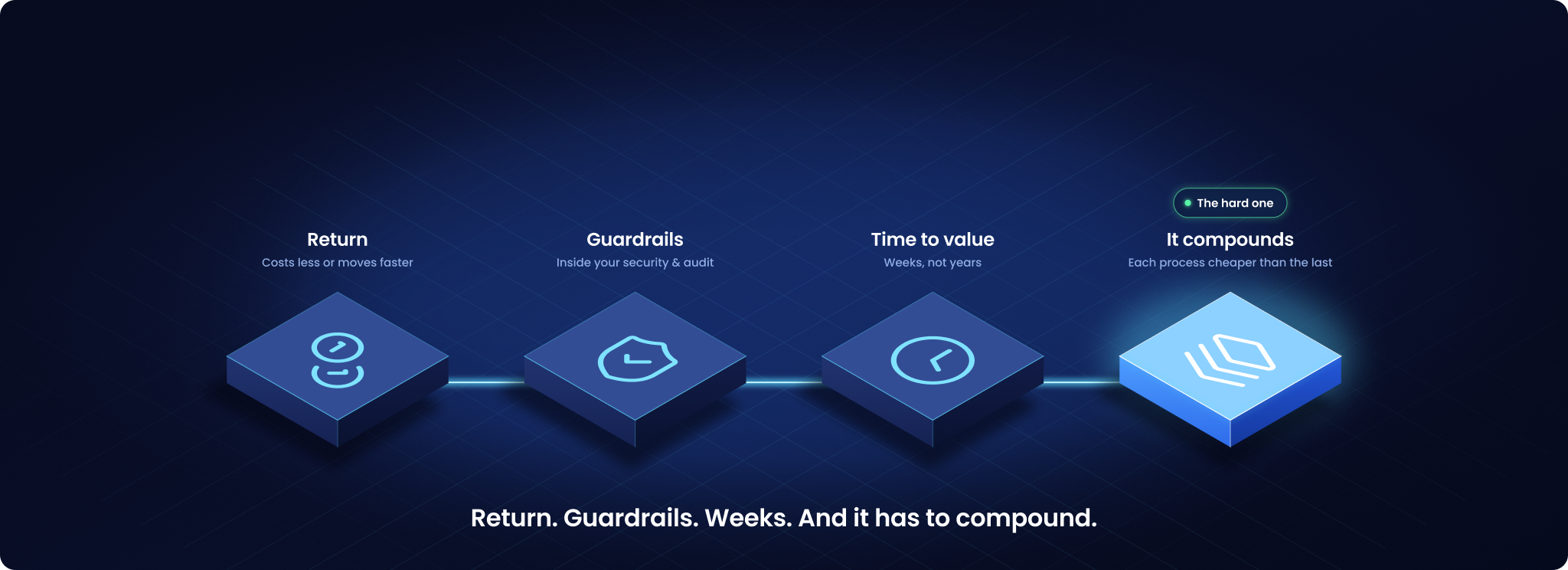
So three things have to be true at once, and almost nobody gets all three. Return: a process that measurably costs less or moves faster. Guardrails: that process runs inside the enterprise’s own security, audit and approval boundaries. Time to value: in weeks, not after a multi-year platform build. And a fourth, which is the hard one. The return must compound. The second process has to be cheaper to automate than the first, and the twentieth cheaper still. Most deployments today are one-off wins that decay. That is the gap the market is now pricing, and it is the gap this investment is about.
Where the process actually lives
Start with HR, because that is where we started. An employee’s leave request does not live in Workday. It lives across Workday, a policy document on SharePoint, a manager’s approval in email, a payroll rule in SAP, and three exceptions that exist only in the head of a tenured HR business partner. The system of record holds the data. The process lives in the gaps between systems.
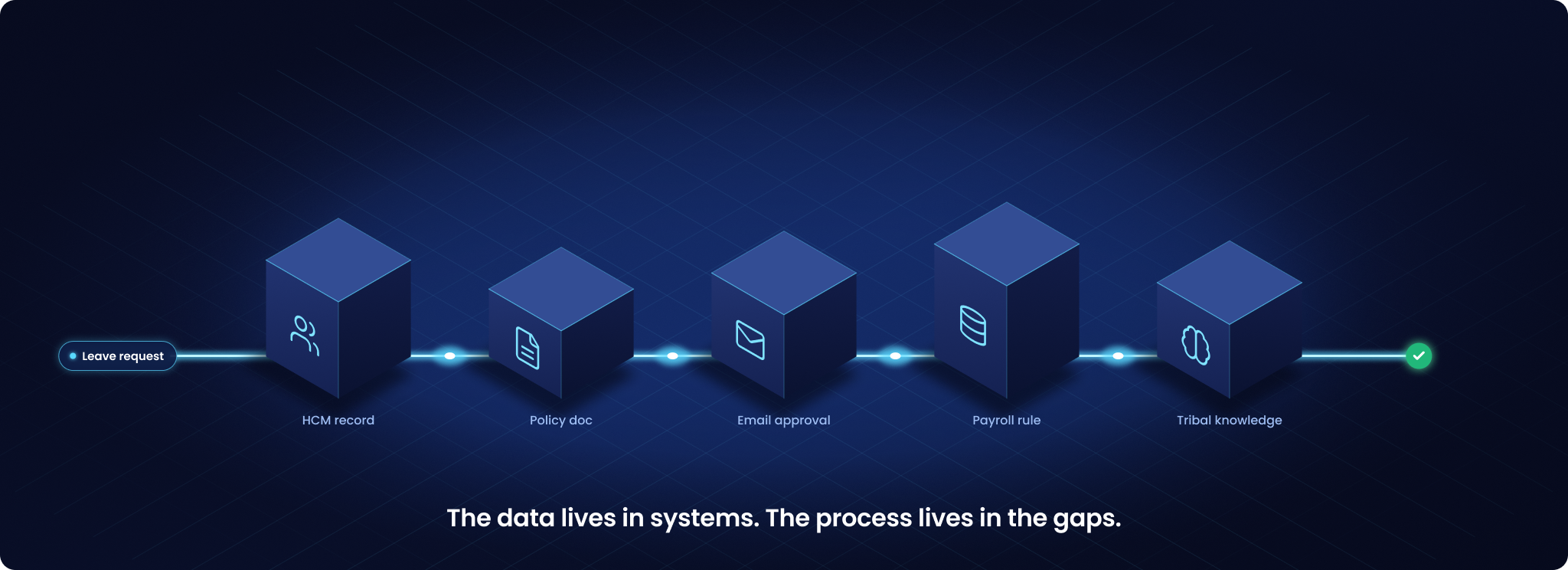
That is the pattern across the back office, not just HR. Onboarding touches identity, ticketing, procurement, finance and facilities. A vendor payment touches ERP, a contract repository, an approval matrix and a bank portal. Every enterprise back-office process is a chain of hand-offs, and every hand-off is where work goes to wait. MIT’s data points the same way: more than half of AI budgets go to sales and marketing, yet the strongest returns come from back-office automation. The value is in the plumbing.
For twenty years the answer was to put the process inside the application. Each SaaS tool owned its slice of workflow. The result is the enterprise we all recognise: dozens of systems, each a local optimum, with people as the integration layer. Workflow stayed married to wherever its data lived.
Agentic AI breaks that marriage. An agent can read a policy, query Workday, reason over an exception, write back to SAP and close the ticket. For the first time the process can be lifted out of the applications and run as its own thing. Workflow is no longer where its data lives. It is where its user is.
We call that lifted layer the agentic plane. Its job is to extricate the process from the systems, run it with the right guardrails, and hand the result back. Three properties matter.
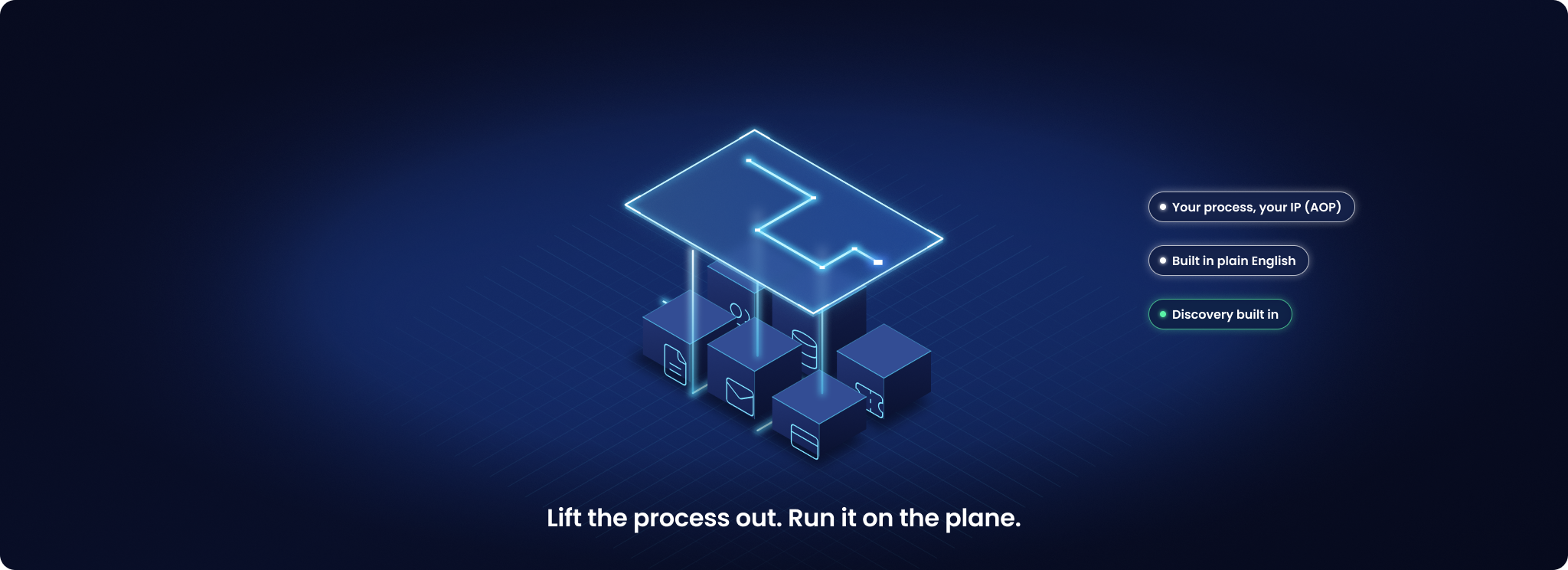
First, the process stays the customer’s own. The codified process, what we call an Agent Operating Protocol, is the customer’s IP. It describes how this company does leave, onboarding or vendor payment, with its exceptions and its approvals. It is not a vendor template with a logo swapped.
Second, building is democratised. The operators who run a process describe it in plain English. The harness turns that description into an executable agent with observability, evaluations and state built in. The harness has to understand processes, not just prompts: who approves, what is reversible, what must be logged, where a human steps in. That is what separates an agent that runs a process from a chatbot that talks about one.
Third, discovery is part of the plane. Most enterprises cannot list their own processes, let alone rank them by automation value. So the plane has to mine how work actually flows across systems, surface what is worth automating, and then measure what each agent saved once it runs. Finds, builds, tunes. A loop, not a project.
That is what it is really going to take. Not a better model. A plane that pulls the process out, keeps it yours, lets your own people build it, and gets cheaper with every process it absorbs.
Why every enterprise wants to build
Customers get this. Not every detail of the architecture, but the strategy. In almost every CIO and CHRO conversation we have, the instinct is the same: we want to build this ourselves.
The instinct is right. A tool you buy is a tool your competitor can buy. What compounds is the body of codified process that only you own: your approval matrices, your exceptions, your policy interpretations, your tribal knowledge made executable. Over time that corpus is the edge. Not the model, not the single application, but the system of how your company works, expressed in software. SaaS as we know it will not vanish tomorrow. But over a period of years, the value migrates from the application that holds the data to the layer that runs the process.
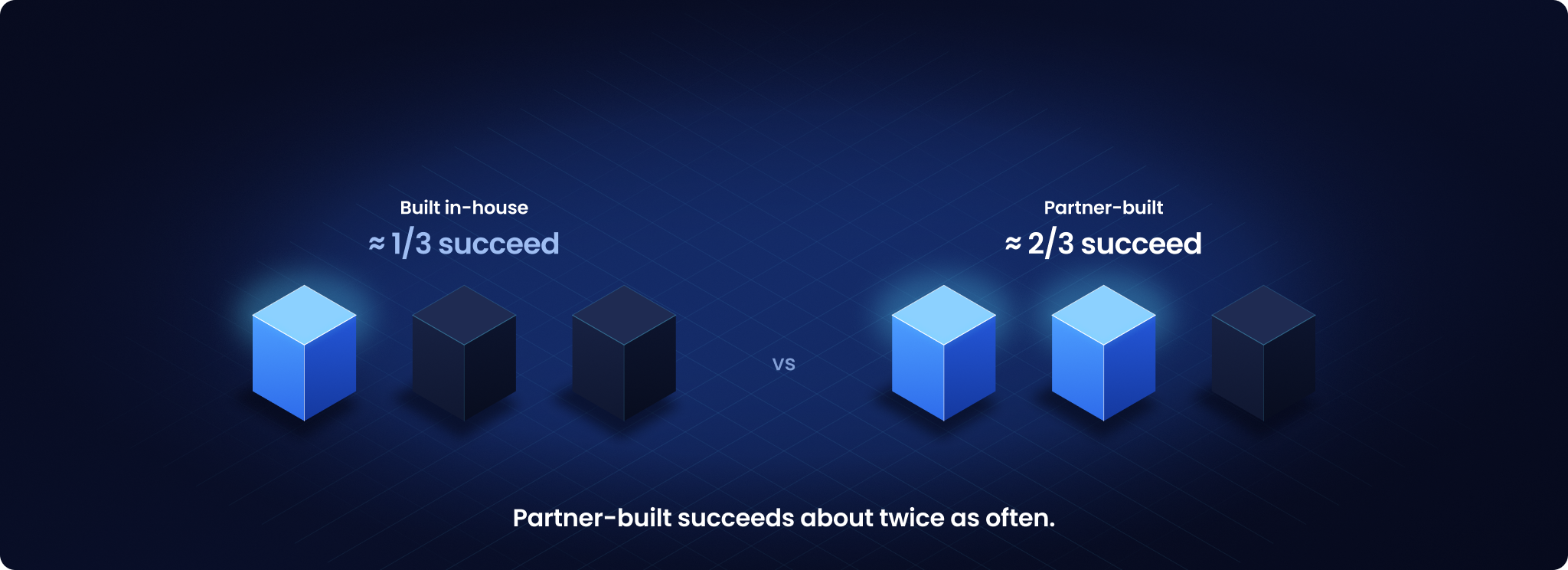
The execution usually goes wrong. Building the plane from scratch means building orchestration, integration adapters to two hundred systems, state management, evaluations, audit, role-based guardrails, and a way for non-engineers to express a process. That is a platform company’s roadmap, not a back-office team’s. MIT’s numbers are unforgiving here: partner-built deployments succeed about two-thirds of the time; internally built systems about one-third. Gartner’s 40% cancellation forecast is mostly this failure mode, dressed up as ambition.
And there is a quieter cost. Every engineer you point at building an agent platform is an engineer not pointed at your product, your customers or your core. An insurer that builds agent infrastructure has become a part-time software vendor with no customers. The organisation drifts off its core, and the drift is hard to see on any single quarter’s budget.
So the enterprise is caught. Buy a tool and you rent someone else’s process. Build the plane and you lose years and your focus. The resolution is to separate the two layers and be precise about which one you must own.
Build how your company works, not the plumbing
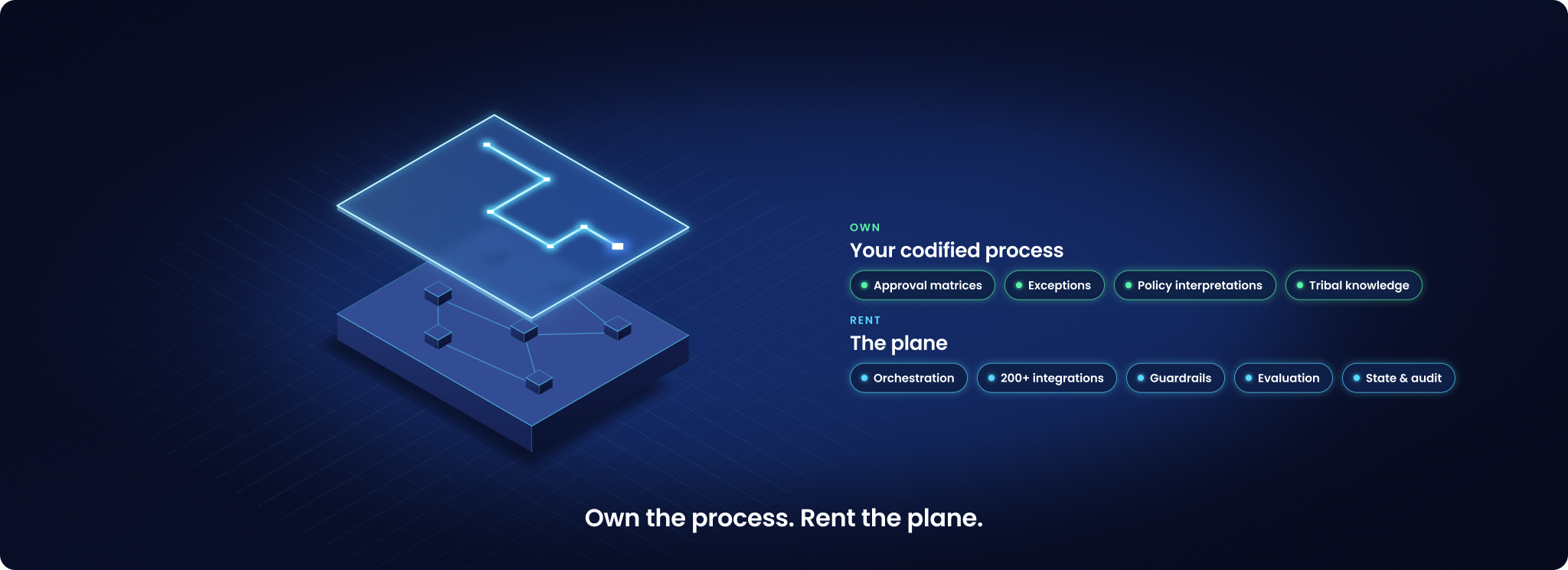
Own the process. Rent the plane.
What an enterprise must build is not infrastructure. It is the codified version of how the company works: the people, the process and the technology, written down in a form that executes. Which approvals exist and why. Which exceptions are policy and which are habit. Where a human must sign and where one merely used to. That corpus is yours, it is defensible, and no vendor can ship it to you. Everything underneath it, orchestration, integration, guardrails, evaluation, is commodity in the making and should be bought from someone whose whole business is keeping it current.
This changes who builds. The scarce skill is no longer writing code. Gartner expects 75% of enterprise software engineers to be using AI coding assistants by 2028, up from under 10% in early 2023. The cost of producing software is collapsing. What is not collapsing is the cost of knowing what the software should do. The person who knows how payroll exceptions really get resolved in your company is an HR operations lead with twelve years of tenure, not a machine-learning engineer. She is the builder now.
That is the practical meaning of democratised building. Give the operator a harness that understands processes, let her describe the work in English, and let the plane handle the execution, the logging and the guardrails. McKinsey’s high performers are nearly three times as likely to have fundamentally redesigned workflows, and the report names workflow redesign as one of the strongest contributors to AI impact. Redesign is an operator’s job. It always was. Agentic AI just removed the translation layer between the operator and the machine.
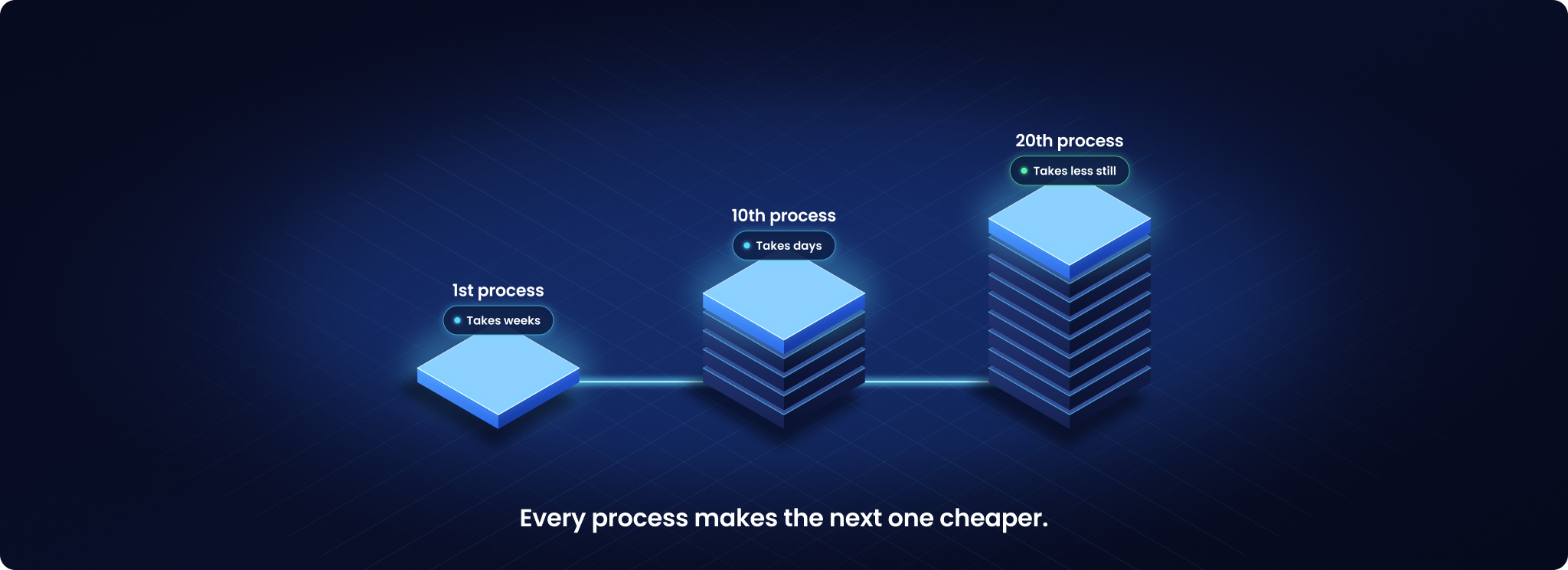
The compounding follows from this. The first process an operator codifies takes weeks. The tenth takes days, because the integrations exist, the guardrails are proven, and the harness has learned how this company approves things. The corpus of codified process grows, and each addition makes the next one cheaper. That is the only form of agentic ROI that does not decay.
What IBM sees in Leena AI
IBM has spent decades inside the world’s largest enterprises. It knows what the back office actually looks like: a 1990s mainframe behind an ERP behind a decade of customisations, with a SaaS layer on top and an outsourcing contract wrapped around the whole thing. Emily Fontaine, who leads IBM Ventures, put it this way in the announcement: what stood out was Leena AI’s focus on the back office, “where agentic AI meets real operational complexity across HR, IT and Finance.” Four things sit behind that sentence.
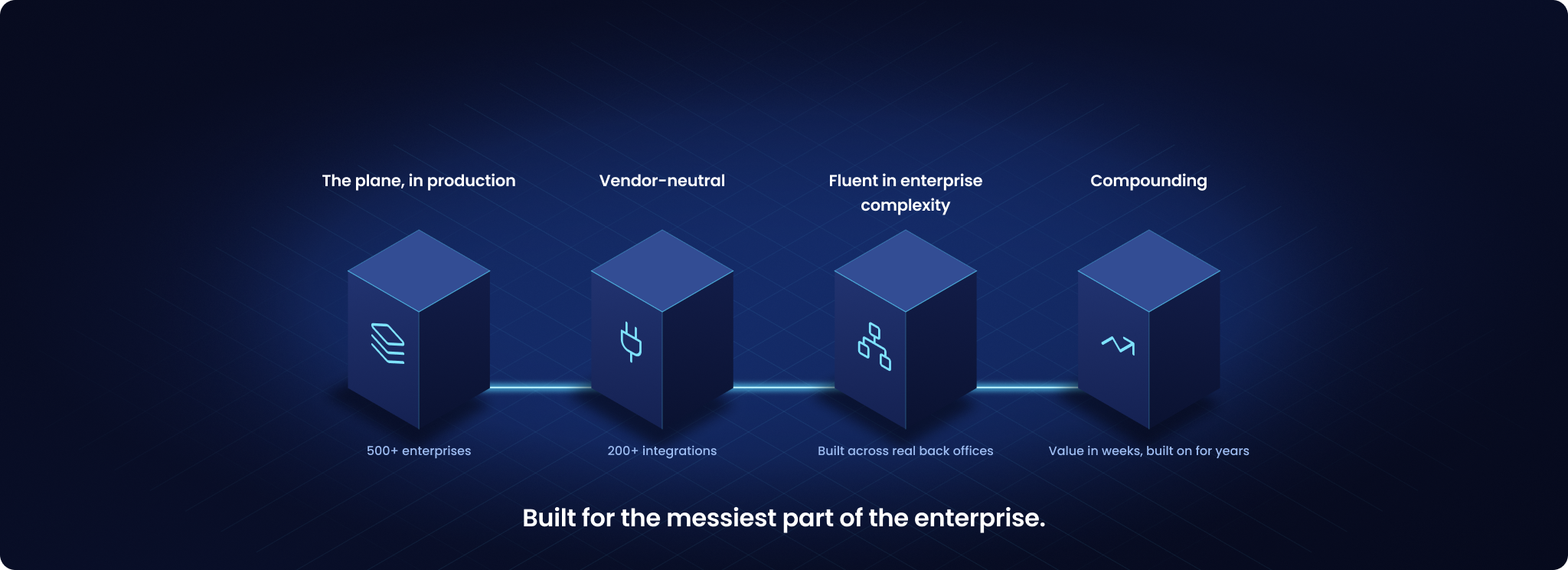
An architecture that makes the plane real. Leena AI Colleague Studio is the agentic plane described above, in production: discovery that mines how work flows across systems, a harness that turns an operator’s English into an executable Agent Operating Protocol with observability and evaluations built in, and performance reporting that feeds fixes back into the AOP. Over 500 enterprises run on it, and Gartner has named Leena AI a Magic Quadrant Leader three years running. That is not a roadmap. It is a reference deployment.
Vendor neutrality. Leena AI does not own a system of record and does not want to. Workday, SAP, ServiceNow, Oracle, Salesforce and the rest are tools the plane calls, reads and writes back to, through 200+ integrations and thousands of skills. That neutrality is not a marketing position. It is what allows the process to be extricated at all. A plane that favours one application is just that application’s workflow engine with a new name.
Fluency in real enterprise complexity. Many agent companies were built in the last three years on top of clean, modern SaaS stacks. They work beautifully in a 500-person startup. The Fortune 1000 is different. Processes there are buried in custom fields, legacy integrations, regional policy variants and undocumented exceptions. Leena AI’s platform was built across that mess, with hundreds of enterprise deployments as its training set. The value is in simplifying extraction from that environment, not in pretending it does not exist.
Compounding, not a point solution. Because the output is the customer’s own codified process, every AOP built makes the next one cheaper, and functional and technical benchmarks across 500+ enterprises let each customer tune its own processes against the field. The customer sees value in weeks and keeps building on the same architecture for years. That is the difference between a tool and a plane, and it is what a strategic investor underwrites.
The short version. Enterprises want agentic ROI that holds, with guardrails, fast. The only version that compounds is one where the enterprise owns its codified process and rents the plane that runs it. Leena AI built that plane for the messiest part of the enterprise, the back office. IBM Ventures looked at that and decided it was worth backing. So did we, several years ago.

Chief Strategy & Marketing Officer. Bain, Walt Disney, and UC before Leena AI; IIT Delhi and Harvard Business School. He maps where agentic AI is actually headed.
Pick your next stop
Hand-picked next reads — short on filler, long on what matters.
 Published 16 October, 2026
“We already have Claude. Why do we need Leena AI?”
 Abhishek Tayal
 Published 12 September, 2025
The Leena AI Journey – From a Dorm Room to Your C-Suite: Building a World Without Back Offices
 Adit Jain
 Published 2 July, 2025
Is Your IT Service Desk Stuck in the Past? Here’s How Automation in ITSM Is Your Next Competitive Advantage
 Prashant Sharma
 Published 20 June, 2025
A CIO’s Guide to Investing in an Agentic AI Platform
Adit Jain Published 14 October, 2026
Introducing Leena Forge: pilot to production in 187 days, then 43. Next, hours.
 Tarun Bhatti
 Published 12 September, 2025
Your 2025 Playbook for Next-Generation IT Automation Services
Prashant Sharma