“We already have Claude. Why do we need Leena AI?”
Claude makes every employee more capable. Leena AI makes the back office itself capable. Those are not the same project.
This question comes up in almost every enterprise conversation now, and it deserves a straight answer rather than a defensive one.
So, plainly: this is not an argument against Claude. Claude belongs in the enterprise. The organisations getting the most out of Leena AI tend to be the ones that use Claude most seriously, and there is a section below explaining exactly why. But a general-purpose assistant and a back-office automation platform are answers to two different questions, and conflating them is the most expensive mistake we see enterprises make in their first year of agentic AI.
Eight years in one room
Leena AI has worked on a single problem since 2018: the enterprise back office. Not marketing copy. Not code generation. Not research. The back office, HR, IT and Finance service delivery, and the thousands of small, unglamorous transactions that keep an organisation upright.
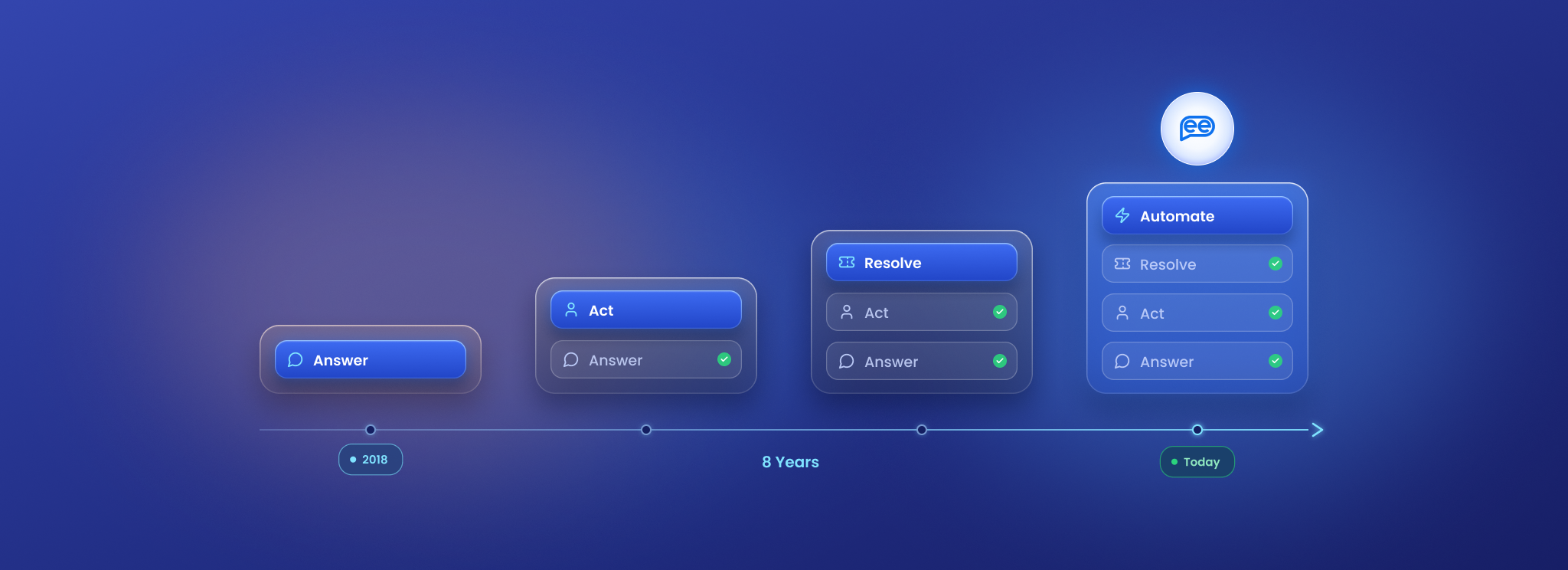
The product followed the problem. It began as a knowledge query assistant, answering questions such as what the parental leave policy is in Singapore. It became a personal assistant that could act, apply for leave, fetch a payslip, update a bank account. It became a ticket resolver, install this software, issue this employment verification letter, restore this entitlement. It is now a platform for automating the back-office process end to end, from the moment the employee asks to the moment the system of record is updated.
Each of those stages taught something that cannot be reasoned out from first principles. The accumulated learning shows up in three places.
1. Time to value
The person who builds automation on Leena AI is almost never an AI engineer. She is an HR operations lead, an IT service manager, a shared-services head. She understands the process better than anyone else in the building, and she has limited appetite for prompt engineering.
A general-purpose platform hands that person a blank canvas. A blank canvas is the most expensive object in enterprise software, because before anything can be built, everything must first be decided.
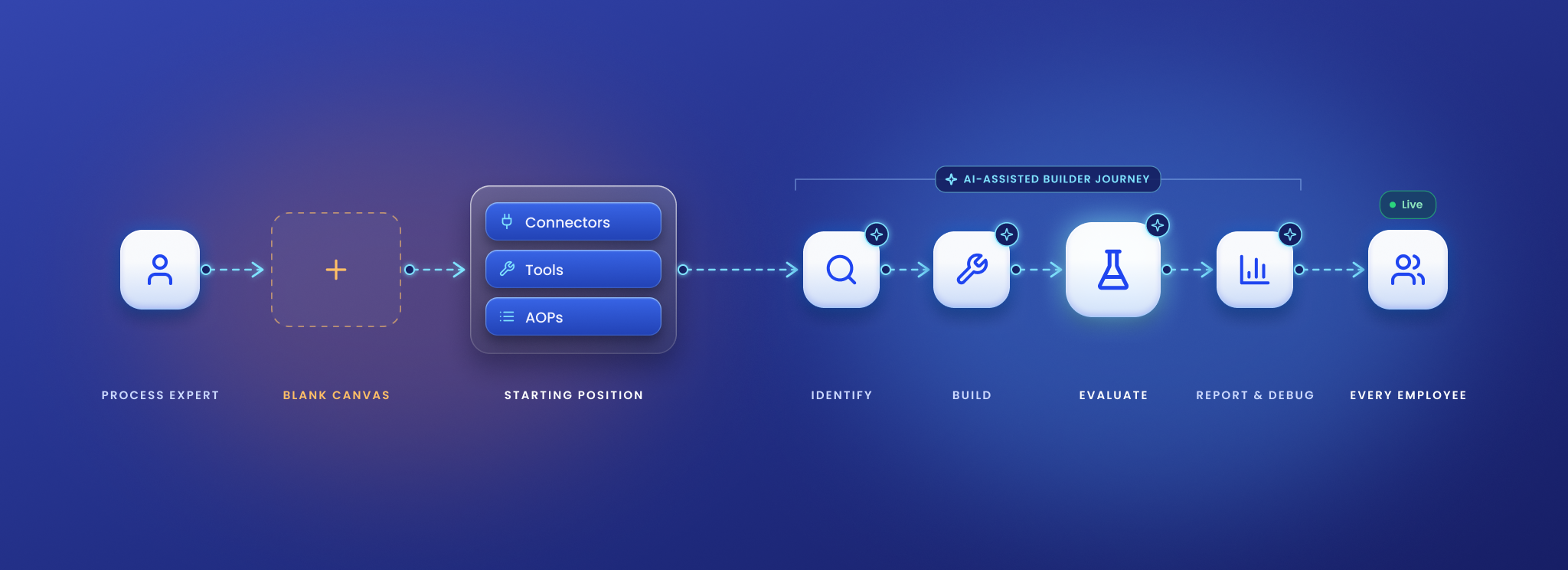
Leena AI hands her a starting position instead: a library of connectors into the systems the back office actually runs on, pre-built tools for the transactions she already performs manually, and AOPs, agentic operating procedures, distilled from how these processes genuinely run across hundreds of enterprise deployments.
The connector is not the valuable part. Reaching Workday is easy, and everybody can do it. Knowing what a payroll team does when a national ID update arrives three days before the payroll cut-off is the part that took eight years. A connector gives an agent reach. An AOP gives it procedure. Enterprises consistently underestimate the distance between the two.
We have also distilled the builder’s journey into four stages, identifying what is worth automating, building it, evaluating it before it ships, and then reporting on and debugging it in production, and put fine-tuned AI assistance behind each one, calibrated for someone who is an expert in the process and a novice in the model.
The third stage deserves a pause. Pre-deployment evaluation is the step nobody demonstrates and everybody needs, because no responsible enterprise puts an agent in front of forty thousand employees on the strength of a good demo.
2. Governance, and the economics behind it
Claude Enterprise has serious governance. Single sign-on, SCIM, role-based access, audit logs, retention controls, a compliance API. None of that is in dispute, and none of it is what we are talking about.
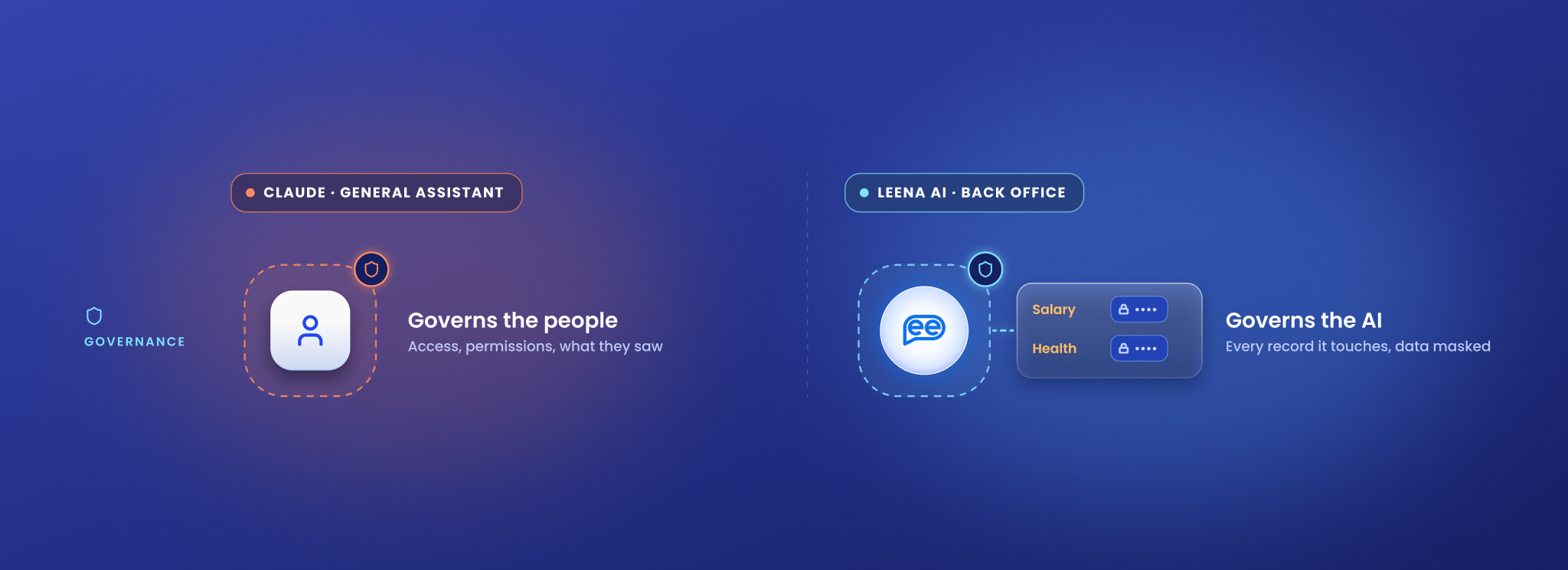
Claude Enterprise governs people using AI. Who has access, what they are permitted to do, what they saw, and how long it is retained. For a general-purpose assistant, that is exactly the right object of governance.
Leena AI governs AI doing work on people’s data. Which employee record was touched. Under whose entitlement. Which parameter was masked before it reached an execution log, a trace, a debugging view or an analytics dashboard. What an unattended workflow did at two in the morning, and on what authority. Administrators can designate parameters as sensitive and have them suppressed wherever they would otherwise surface. The audit trail is written to be read by a compliance officer, not by an engineer, because the back office is where the regulated data lives: salary, health, identity, immigration status, disciplinary history. This is the ground on which privacy incidents become legal escalations.
And then there is the question every CIO arrives at, usually around month nine: what did that actually cost?
Under a consumption model, the seat fee is an access fee and the tokens are the bill. That is an entirely sensible way to price a general assistant, and it is honest about where the cost sits. But it means that when a back-office process runs at volume, token efficiency stops being an engineering concern and becomes a line in the P&L.
Leena AI reports token consumption alongside business outcomes, which makes possible the metric a general-purpose platform is not structured to produce: cost per resolved request. This matters more than it first appears. A platform that must reason its way across an open-ended solution space on every single invocation will spend a great deal to resolve a leave-balance query. A platform that has already narrowed that space, through domain-tuned AOPs, deterministic tools, and retrieval built specifically for policy content, resolves the same query for a fraction of the tokens, and can demonstrate that the figure fell again this quarter.
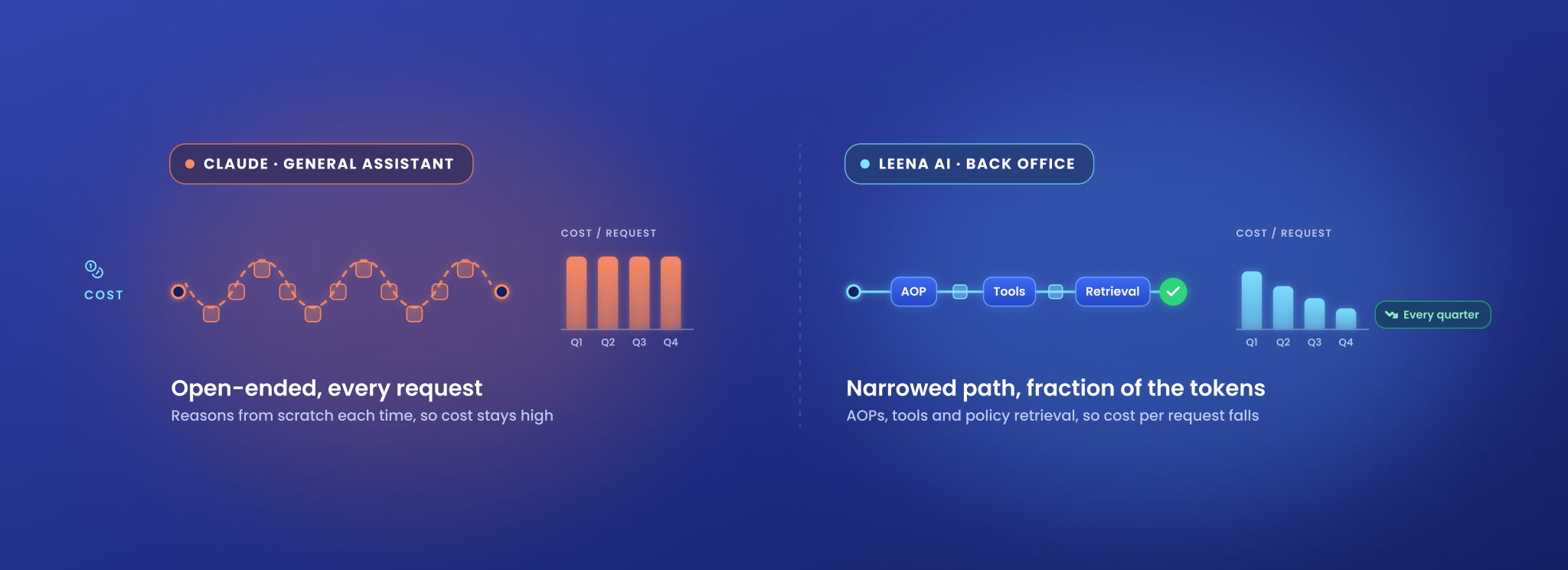
A million dollars of tokens is not a fixed quantity of work. It buys materially more back-office throughput when it is spent along a path that was optimised for the back office.
3. The experience of an enterprise, not of a knowledge worker
Here is the structural point, and it is the one that is hardest to argue with.
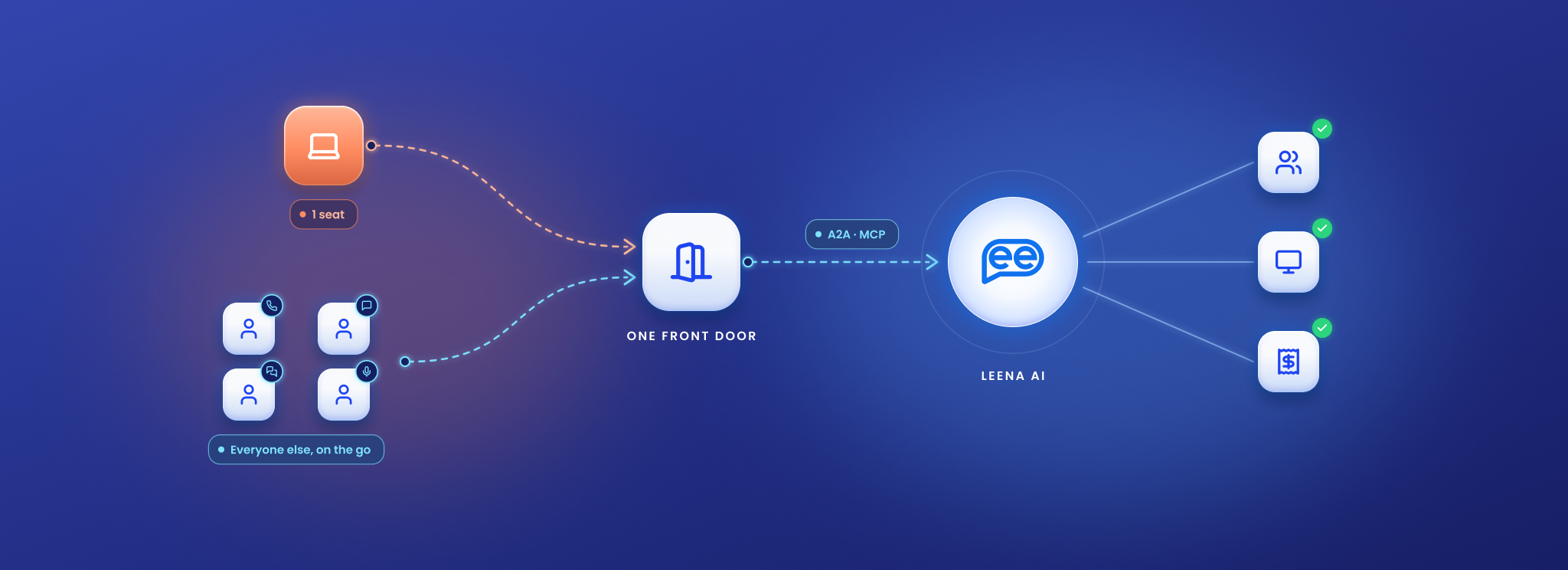
Claude Enterprise is sold per seat, and it is designed for the person holding that seat: someone with a laptop, a corporate email address and a quiet hour. A large enterprise is mostly not that person.
It is the store associate who needs a shift swap and has three minutes before the queue builds. It is the field sales rep filing expenses from a car park. It is the machine operator with no corporate device at all, the nurse between rounds, the driver, the warehouse picker. A retailer with sixty thousand store associates is not going to buy sixty thousand seats so that each of them can check a leave balance. But every one of those people consumes the back office, and every one of them is entitled to.
They approach it the way they always have: a phone call, an SMS, a message in Teams, a voice note inside an app. Leena AI meets each of them where they already are and does not ask anyone to change a habit in order to receive a faster answer.
Those contexts also differ in ways a general-purpose product has no reason to model. A shared kiosk on a shop floor needs an aggressive session inactivity timeout, because the next person to touch that screen is a stranger. A personal device inside Teams does not. Authentication, session handling and identity resolution have to bend around the reality of the worker rather than the convenience of the platform.
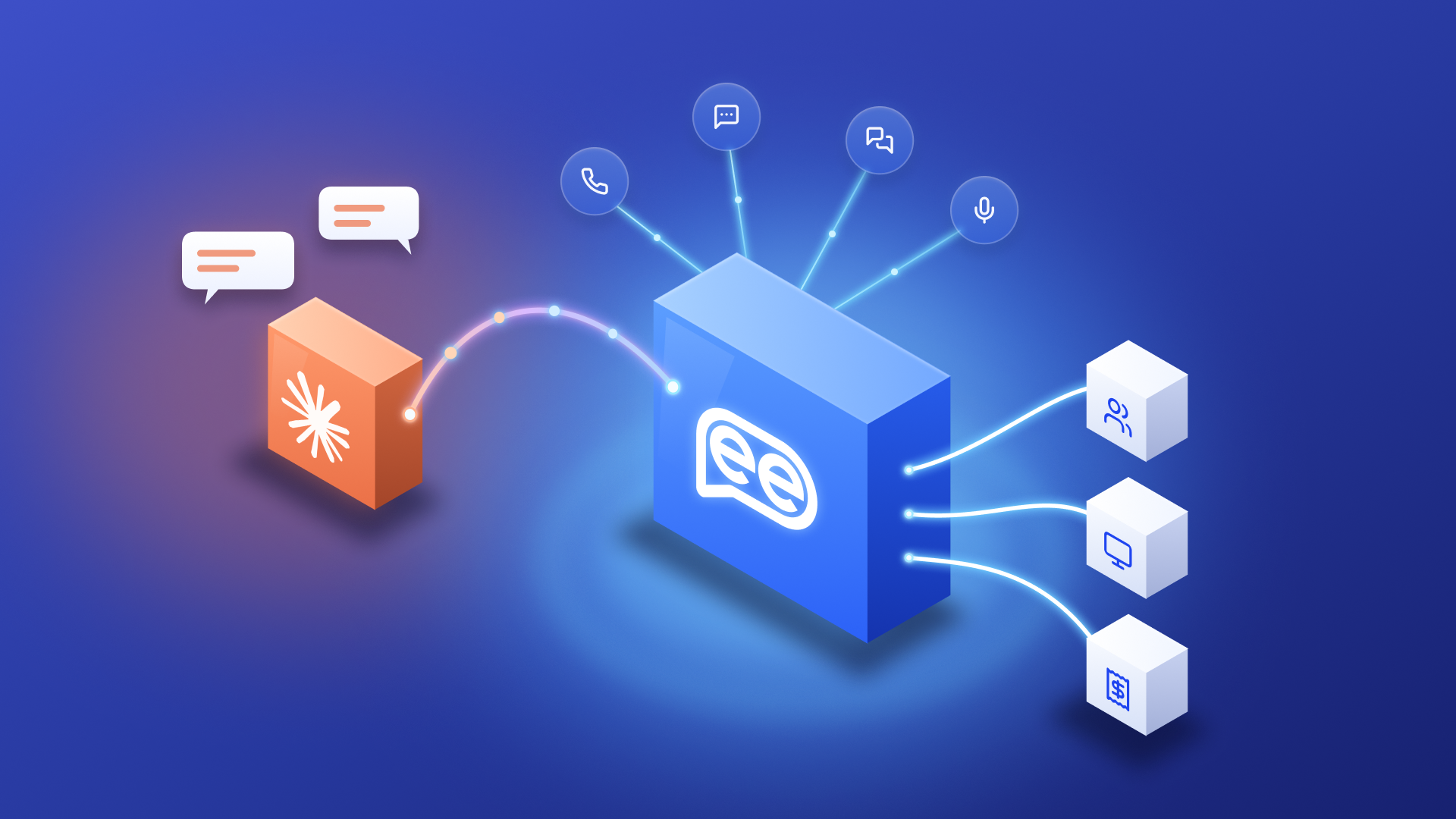
Finally, there is the agent-count problem. Most large enterprises have now run their agentic experiments, and the last thing any of them wants is a sixth agent and a sixth place to look. If an enterprise has already settled on a single front door, Leena AI does not compete with it. It sits behind it, exposed over A2A and MCP, as the specialist to which the primary agent delegates the back office. The employee sees one assistant. The back office gets a platform built for it.
So is Claude redundant? Not remotely.
Claude is where discovery happens.
The early superstar builders, the ones who carry an organisation from curiosity to conviction, will prototype in Claude, and in doing so they will work out what is genuinely automatable: which processes have the volume, the determinism and the clean edges to be worth industrialising, and which merely feel as though they should. That is enormously valuable work, and Claude is exceptionally good at it. Those same builders then build far better on Leena AI, because they arrive already knowing what they want.
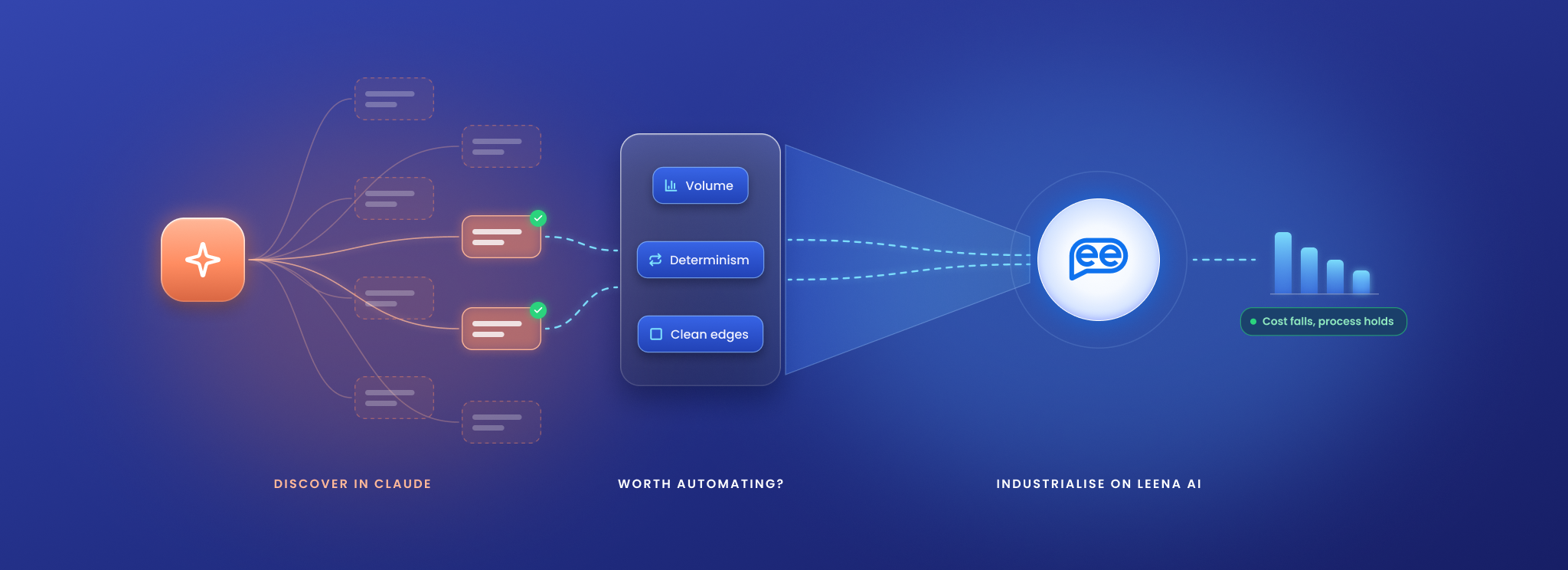
What a general-purpose assistant will not do, because it is not trying to, and should not try to, is bend itself around one enterprise’s back office as that back office changes. Generality is the design goal. Serving the widest possible set of use cases is the entire point, and it is precisely why Claude is as good as it is.
Narrowing relentlessly around a single domain, until the cost per resolved request falls quarter after quarter and the process holds when the process changes, is a different design goal. It is ours.
The question that actually decides this
In an evaluation, the question is usually whether the model can do the task. It can. Frontier models can reason their way through almost any back-office task you are able to describe to them.
The question that determines whether an agentic programme succeeds is the one that arrives in month nine. The process has changed. The builder who set it up has moved teams. An auditor wants to know what the agent did with an employee’s medical record in March. Forty thousand people now depend on it working before nine on a Monday morning, from a shop floor, over SMS. And someone in Finance would like to know what each of those resolutions cost.
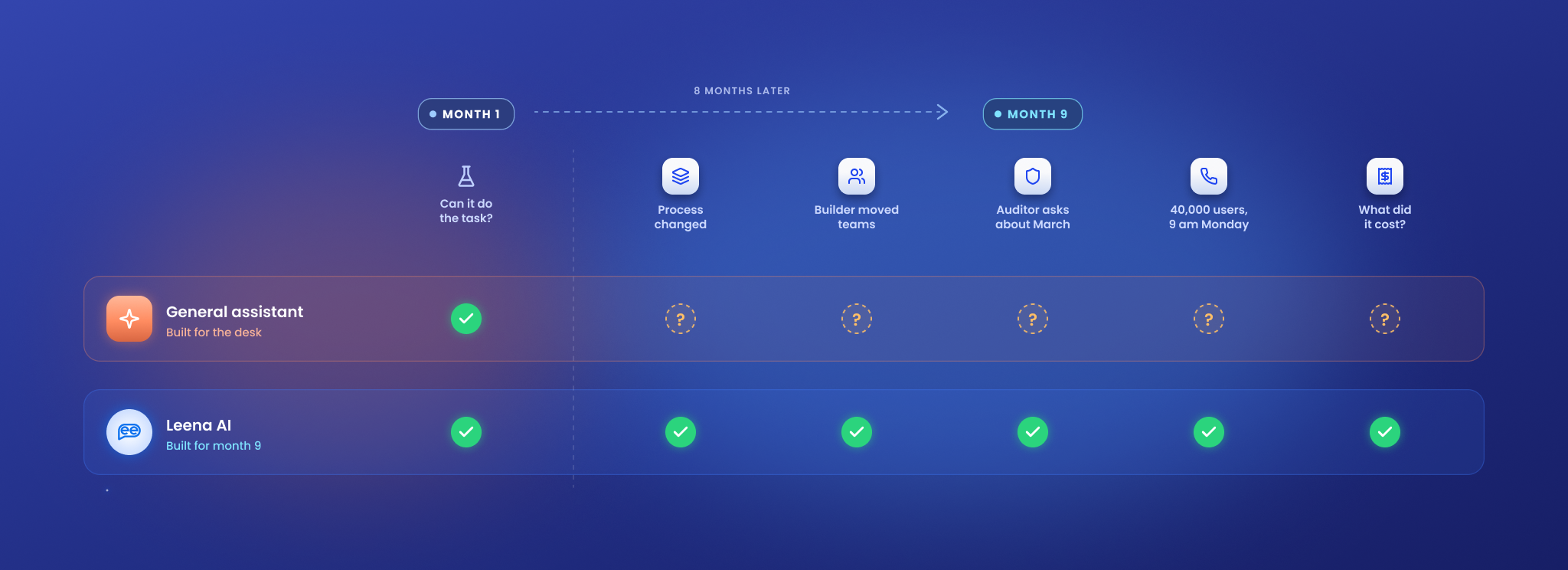
That is the problem Leena AI has spent eight years on. It is not the same problem as making a brilliant assistant available to everyone who has a desk, and an enterprise that is serious about its back office will want both.

Professional with 10+ years of experience currently optimizing technology processes and implementation at Leena AI. He has exposure to both B2C and B2B firms and understand working at scale as well as fast-growth entrepreneurial set-ups.. Apart from the work experience, he graduated from IIT Delhi before completing his MBA from IIM Calcutta.
Pick your next stop
Hand-picked next reads — short on filler, long on what matters.
 Published 14 October, 2026
Introducing Leena Forge: pilot to production in 187 days, then 43. Next, hours.
 Tarun Bhatti
 Published 12 September, 2025
The Leena AI Journey – From a Dorm Room to Your C-Suite: Building a World Without Back Offices
 Adit Jain
 Published 28 August, 2025
AI Agents vs. Agentic AI: Unlocking the Future of Enterprise AI
 Mayank Kapoor
 Published 2 July, 2025
Is Your IT Service Desk Stuck in the Past? Here’s How Automation in ITSM Is Your Next Competitive Advantage
 Prashant Sharma
 Published 20 June, 2025
A CIO’s Guide to Investing in an Agentic AI Platform
Adit Jain Published 10 September, 2025
Meet Leena AI Voice: The Fastest Way to Get Work Done by Speaking
 Anand Prajapati