
Agentic AI for HR has two steps. Most teams have only taken the first.
Agentic AI for HR has two steps: AI assistants that answer, and AI Colleagues that run the process end to end. Where the real cost lives.
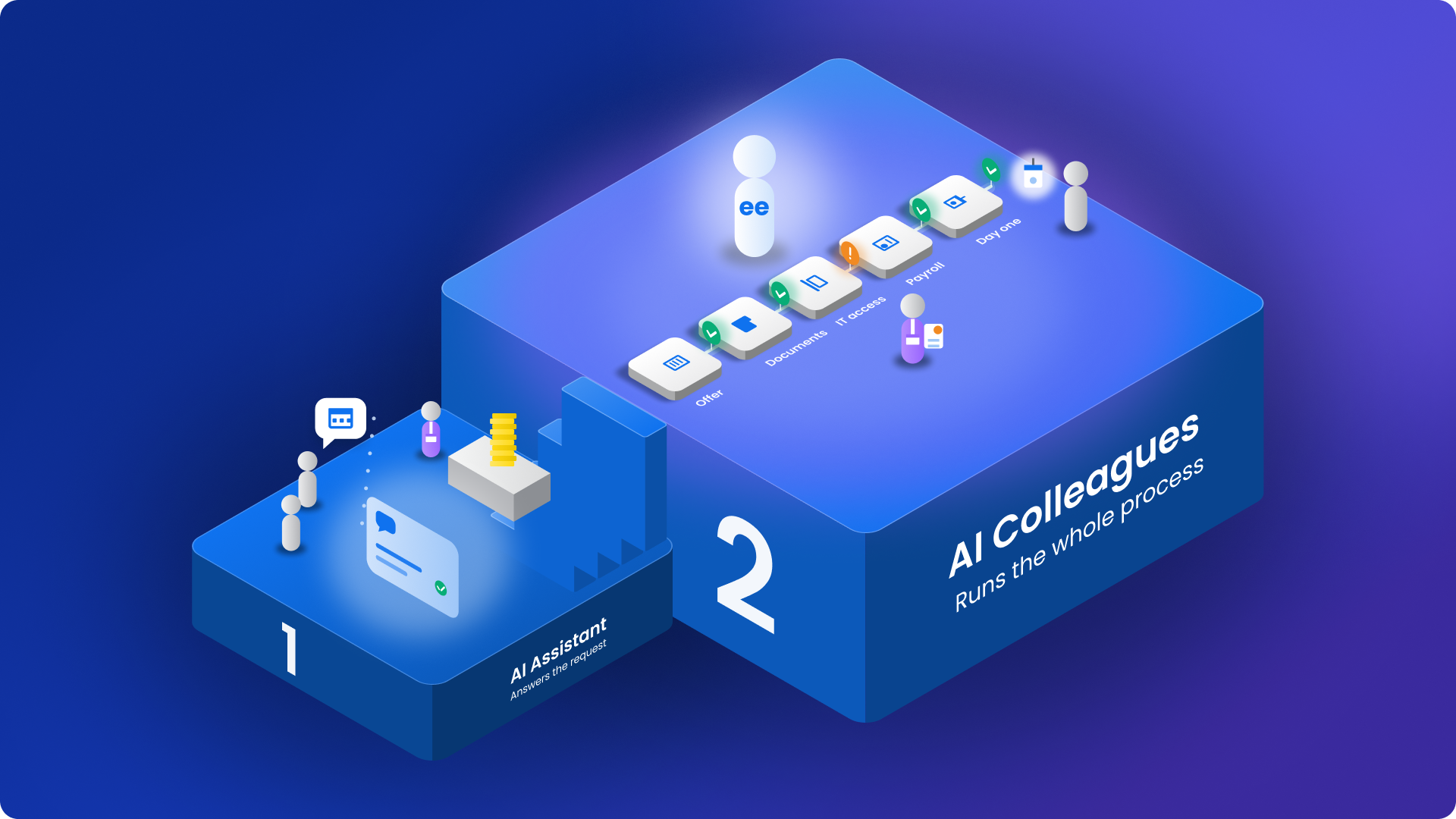
On October 18, Brent Ludwig and I ran a session called “AI Colleagues for HR” at the Consero CHRO Forum in Houston. The room was full of HR leaders who are already deep into AI. That made the conversation more useful than most.
Brent and I talk to HR leaders every week. Two years ago, the conversation was about tickets. “I have too many requests. Help me deflect them.” Today the best teams have moved past that. They have the chatbot. Now they are asking a harder question: how do we automate the process behind the request?
Here is what we talked about, and what the room told us back.
We started with a show of hands
We asked one question: which process eats the most of your team’s time?
- Recruiting and hiring: 6 hands
- Payroll: 5
- Benefits: 3
- Certifications and compliance: 3
- Onboarding: 2
- HR helpdesk and self-service: 1
That’s 20 hands. One for the helpdesk. That is the result that matters. The work that still costs HR teams time is not answering questions. It is multi-step processes that cross systems, teams and approvals.
Step 1 fixed the question. Step 2 fixes the process.
We frame agentic AI in HR as two steps.
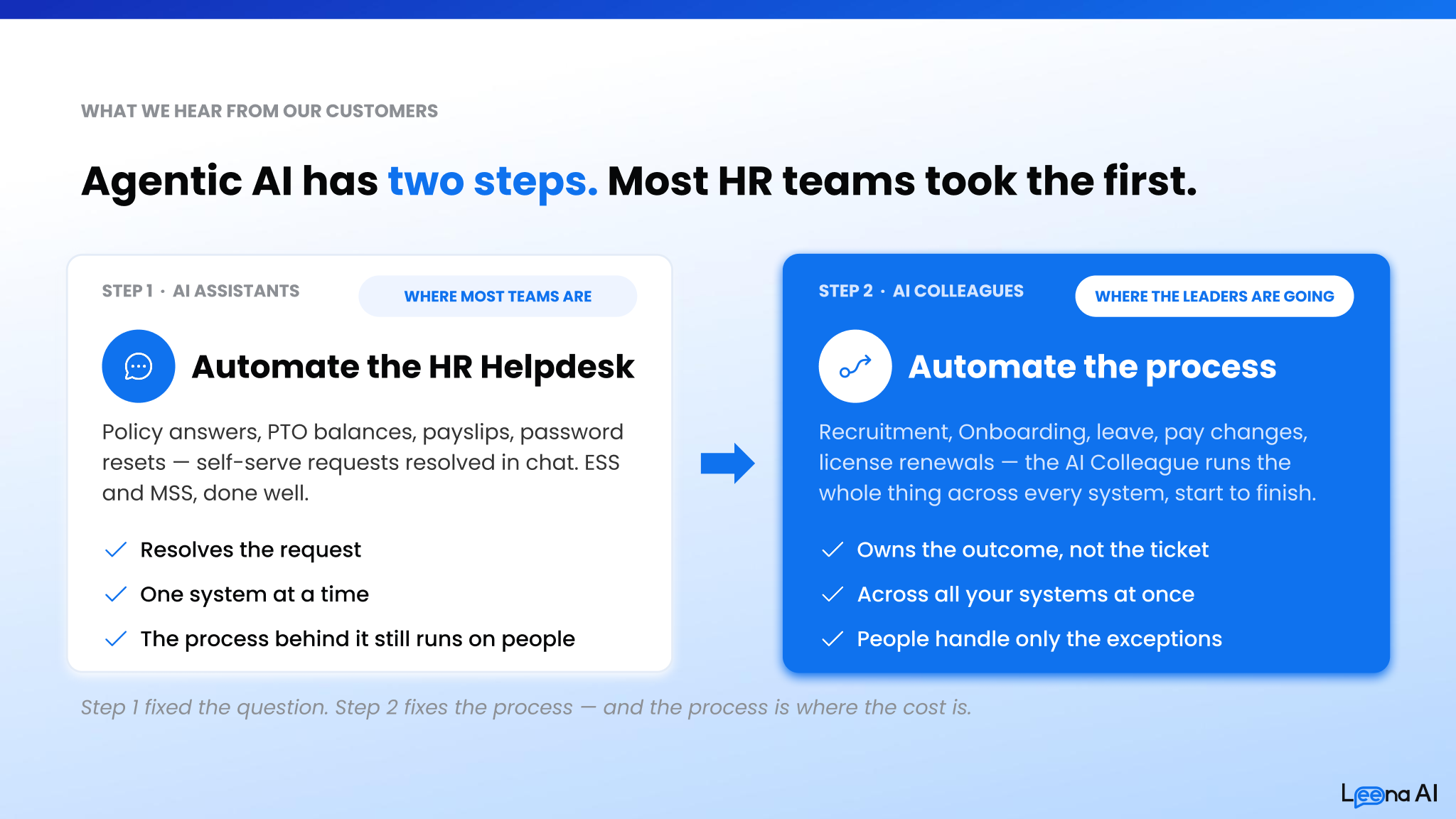
Step 1 is AI assistants. An employee asks about PTO, a payslip, or a policy. The assistant answers. ESS and MSS, done well. Most HR teams are here, and it works. But it resolves one request in one system. The process behind it still runs on people.
Step 2 is AI Colleagues. Recruiting, onboarding, leave, pay changes, license renewals. The AI Colleague runs the whole process, across every system, start to finish. It owns the outcome, not the ticket. People handle only the exceptions.
Step 1 is easy. Step 2 is hard. And Step 2 is where the cost is.
Why Step 2 is hard: look at where your processes live
When we ask HR leaders how many applications sit in their HR stack, the most common answer is not a number. It is “honestly, I don’t know.” When we dig in, it is usually somewhere between 40 and 100+.
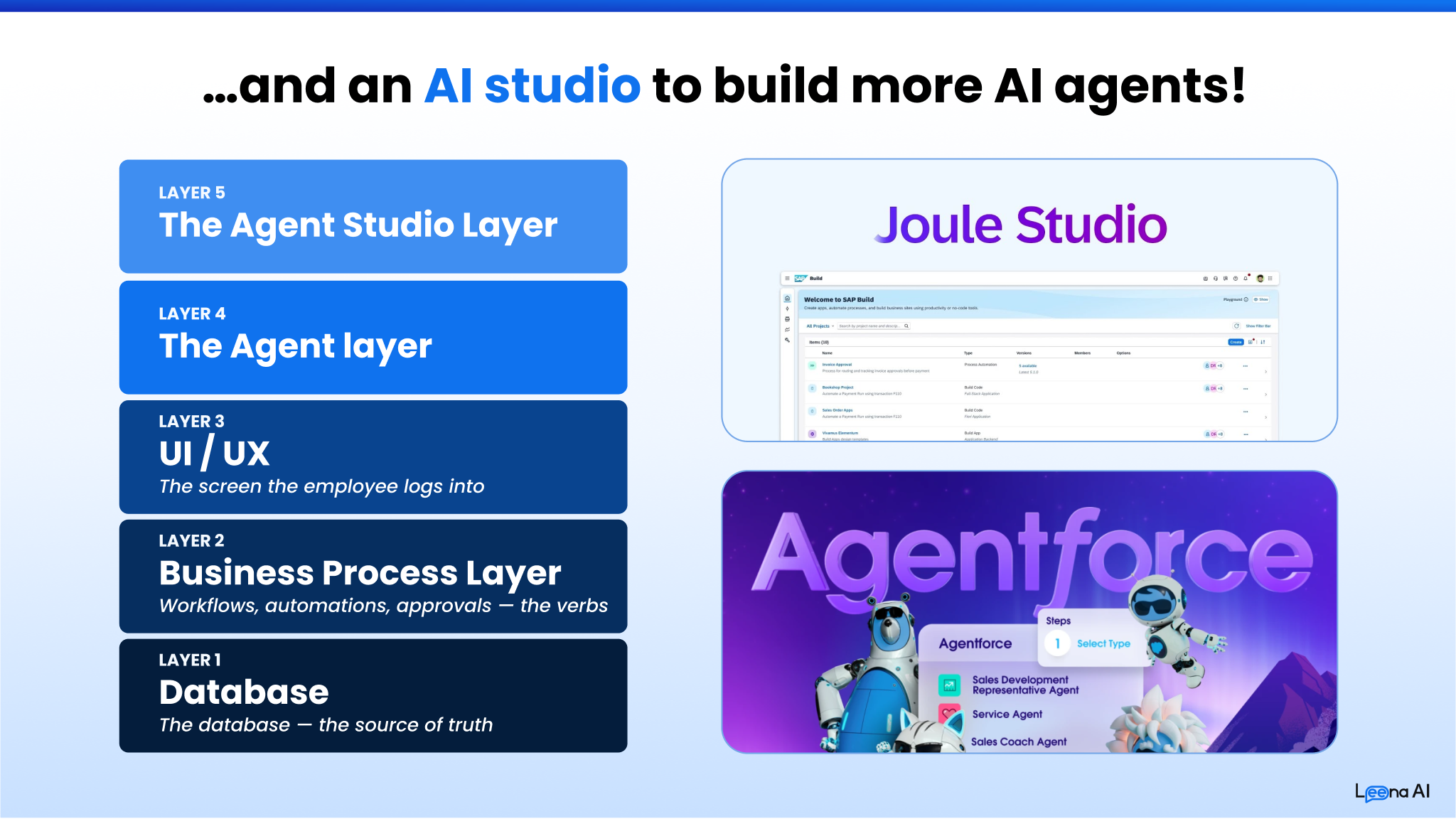
Every one of those apps is built the same way. Three layers:
- Database. The source of truth.
- Business process layer. Workflows, automations, approvals.
- UI/UX. The screen the employee logs into.
In the last two years, every vendor added a fourth layer: an AI agent. Then a fifth: an agent studio to build more agents.
That sounds like progress. Here is the catch. Out of the box, the apps don’t talk to each other. Building deep integrations across 40 to 100+ of them is hard, and keeping them working as each vendor ships updates is harder. So the agents don’t talk to each other either. Every agent only acts inside its own application.
A real HR process never lives in one app. A job change touches core HR, payroll, comp, IT and sometimes facilities. So who connects the steps today? Your people. They are the glue. And that glue is the cost.
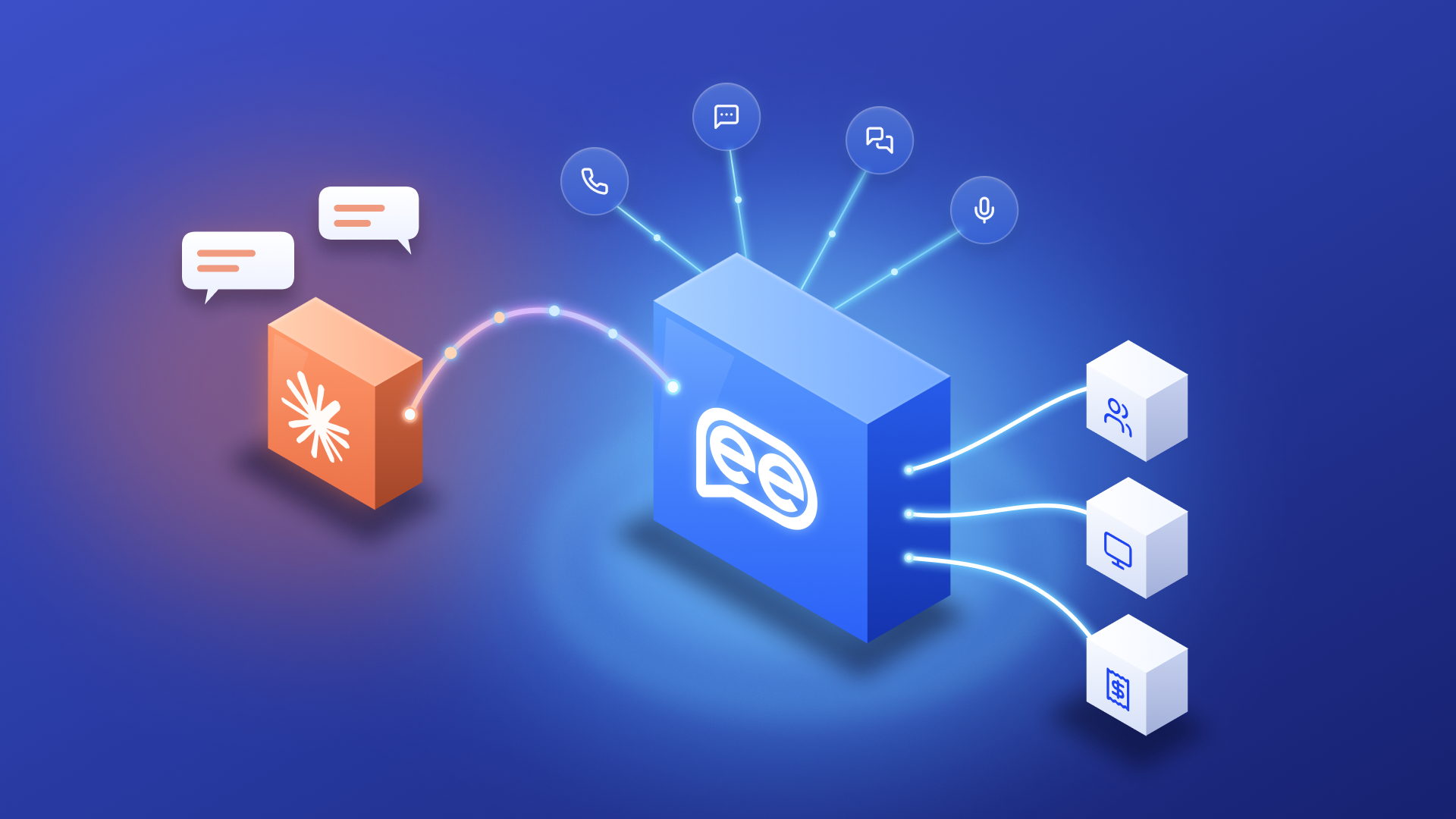
The fix: an agentic layer you own
Our view is simple. The business process and the employee experience should move into a layer you own. It should be independent of any single vendor, and run by the people who own the process, not the people who own the code.
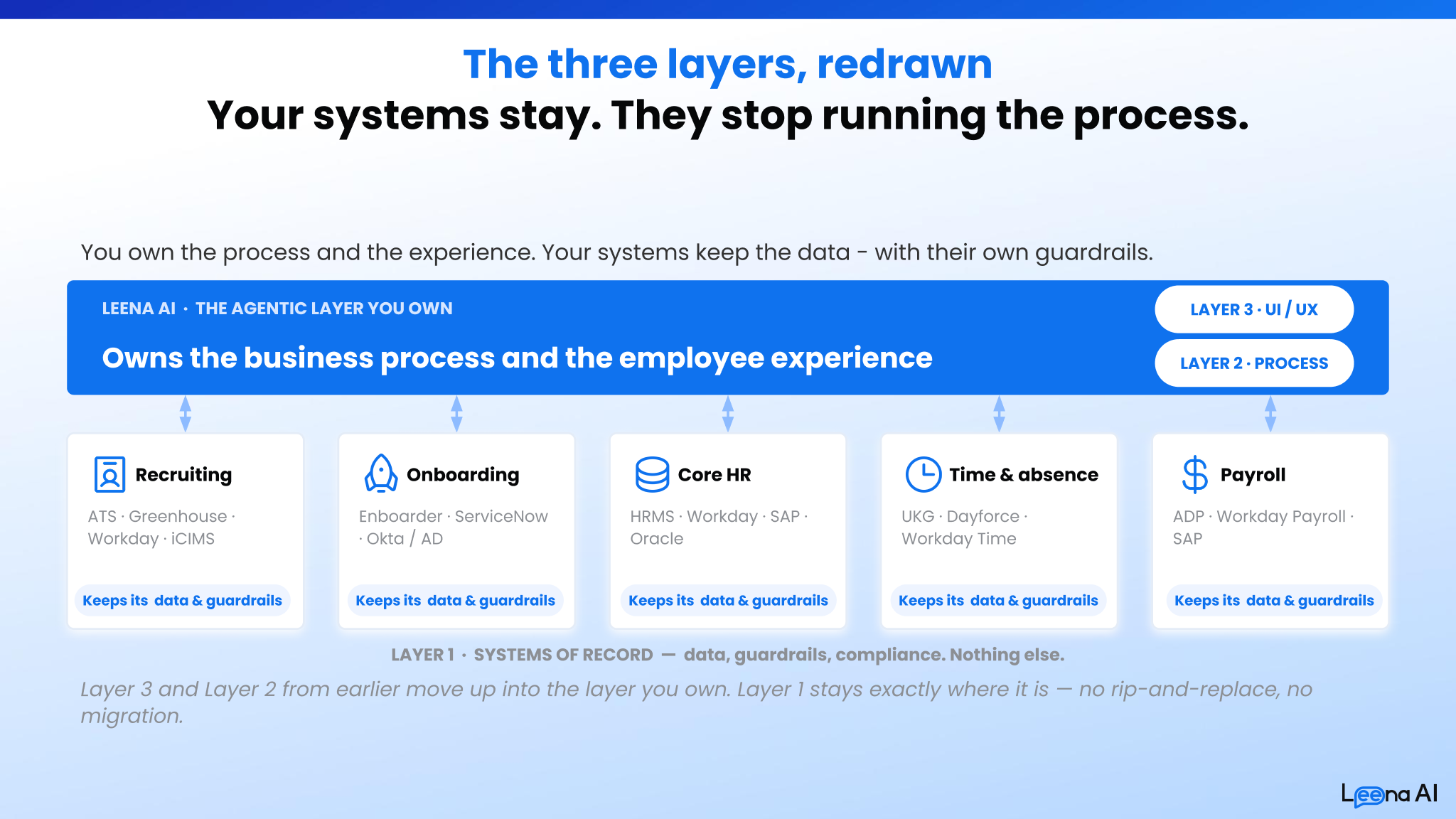
Your systems of record stay exactly where they are. Workday, UKG, SAP, Oracle, ADP keep the data, the guardrails and the compliance. No rip and replace. No migration. They just stop running the process.
Every major vendor wants you inside its walled garden. Your CIO wants to stay nimble and avoid lock-in. A thin process layer across all of your systems gives both sides what they want. It also lets you meet employees where they already are, in Teams, Slack, SMS or WhatsApp, instead of making a frontline worker log into an HRMS to report a life event.
This only works with deep integrations. Leena AI connects to 200+ applications across the HR, IT and finance stack. That is what lets one AI Colleague run a process end to end.
Proof, in production
We walked through three examples. All three are live, and all three happen to be in Texas, across healthcare and transportation.
CHRISTUS Health: 24/7 self-service for 53,000+ employees. Clinical staff were losing time to routine HR and IT requests across 50+ helpdesks, with no 24/7 support. Frontline workers on night shifts had no one to ask, and many don’t have a laptop. Today HR and IT self-service is live across 50+ hospital sites on web and Microsoft Teams, with 80% ticket deflection. This is Step 1, done at scale.
Beacon Mobility: hiring school bus drivers at scale. Beacon runs the orange school buses you see every morning. It receives 200,000+ applicants a year across five regions, each with its own compliance rules. Recruiters reached only 30% of applicants. First contact took 19 days, and $6M a year in routes went unserved because the best drivers took other offers. Now one AI Colleague owns the funnel from application to interview-ready, across Workday, HireRight, SMS and email. A recruiter steps in only if a compliance check fails. First contact dropped from 19 days to 15 minutes. Beacon reaches 330% more applicants, with $7.5M+ in annualized impact. That is Step 2: the hiring funnel, from application to interview-ready, automated end to end.
A multi-site health system: clinician license renewals. When a clinician’s license lapsed, they were locked out of the EMR mid-shift. That pulled five teams into days of rework, about 40 times a year. Now one AI Colleague tracks every expiry, reminds clinicians weeks ahead, lets them renew in a 30-second chat, and writes the record back to the HRMS. EMR lockouts went from ~40 a year to zero, with $2.4M+ in annual rework avoided. That is Step 2: clinician license renewals, automated end to end.
The next process gets automated faster than the last
Here is a pattern we see across most of our customers. Twelve months ago, an enterprise might automate two or three processes a year. Each one was an IT project: scoped, built, integrated and tested by engineers.
Today the same enterprises automate two or three processes a quarter.
The difference is who gets to build.
Introducing Leena AI Forge
That is why we built Leena AI Forge. The old model treats every HR process as an IT project. A forward-deployed engineer or an SI builds each workflow. Every tweak needs a ticket. The process owner waits in a queue.
With Forge, the process owner builds it:
- Describe it. Your recruiter or HRBP explains the process the way they would brief a new hire.
- Forge builds it. It drafts the process, connects the systems and writes the tests.
- Forge checks it. It runs real cases and flags gaps and permissions.
- The owner ships it. Approve and go live. Change it tomorrow, with no IT ticket.
Nothing publishes until a human approves it. When something breaks a month later, you ask Forge why. It reads the logs, finds the issue and fixes it.
The expertise that matters is knowing how HR works, not how code works.
What the room told us
The best part of the session was the table workshop. We asked each table one question: which single HR process would you hand to an AI Colleague first, and why that one?
Two stories stood out.
Ten months to automate benefits reconciliation. One benefits leader shared that her team has spent ten months moving benefits reconciliation to an AI solution. She couldn’t hire anyone to do the work. The AI is now close to useful, but every fix goes through an external development team. “Recognize nicknames, not just legal names.” “Match on employee number when the vendor doesn’t send an SSN.” Each small change joins a queue and comes back weeks later. Her team knows exactly what needs to change. They just can’t change it.
That is the problem in one story. Every company runs the same process a little differently. The person who knows those nuances should be the one building and fixing the automation.
Nine platforms, zero training. Another leader described an organization that bought nine separate solutions that operate in silos. Nobody received training on any of them. A $2M consulting assessment is sitting unused because no one could act on it. Technology alone doesn’t fix that. People, process and governance come first. What AI can do is connect your knowledge sources and show you where they conflict.
That led to the most common blocker we see in any AI rollout: content sanity. If your SharePoint, your policies and your HRMS say different things, AI will too. If humans can’t resolve it, AI can’t either. That is why we built the conflict analysis dashboard. It scans content across multiple knowledge bases flags where two articles/policies give different answers. We also went ahead and built a complete knowledge health dashboard to capture other noisy signals (example: staleness, expiry etc) in the enterprise knowledge base and guide e nterprises to optimize their knowledge for agentic search.
One question to take back to your team
Go back to the poll. Pick the one process that eats the most of your team’s time. Then ask:
- How many systems does it touch?
- Who is the glue between them today?
- Who on your team knows that process well enough to explain it to a new hire?
If you can answer the third question, you already have your builder.
Thank you to Consero and to every HR leader who joined us in Houston. If you want to work through your own processes, your systems and your workforce, book a working session.
Tarun Bhatti is VP of Product Marketing at Leena AI. He co-presented this session with Brent Ludwig, VP of Professional Services at Leena AI.

VP Product Marketing & Brand Marketing. Enterprise GTM at AppNexus, HubSpot, and Nextiva. Tarun separates AI's signal from its noise.
Pick your next stop
Hand-picked next reads — short on filler, long on what matters.
 Published 28 October, 2026
The first iPhone shipped without a keypad. Why does your AI-native platform ship with an extensive UI?
 Hammad
 Published 14 October, 2026
Introducing Leena Forge: pilot to production in 187 days, then 43. Next, hours.
 Tarun Bhatti
 Published 23 October, 2026
Publish your failure rate: why we benchmark before we ship
 Mayank Kapoor
 Published 21 October, 2026
What IBM Ventures’ Investment in Leena AI Really Means
 Sayan Haldar
 Published 16 October, 2026
“We already have Claude. Why do we need Leena AI?”
 Abhishek Tayal
 Published 8 September, 2025
The Leader’s Guide to AI SaaS Company Names (2025)
 Prashant Sharma


